Why a padel Americano counts points, not wins
Americano scoring looks odd the first time you see it: no sets, no games, and a loss still earns you points. Here is the logic, and why it makes socials work.
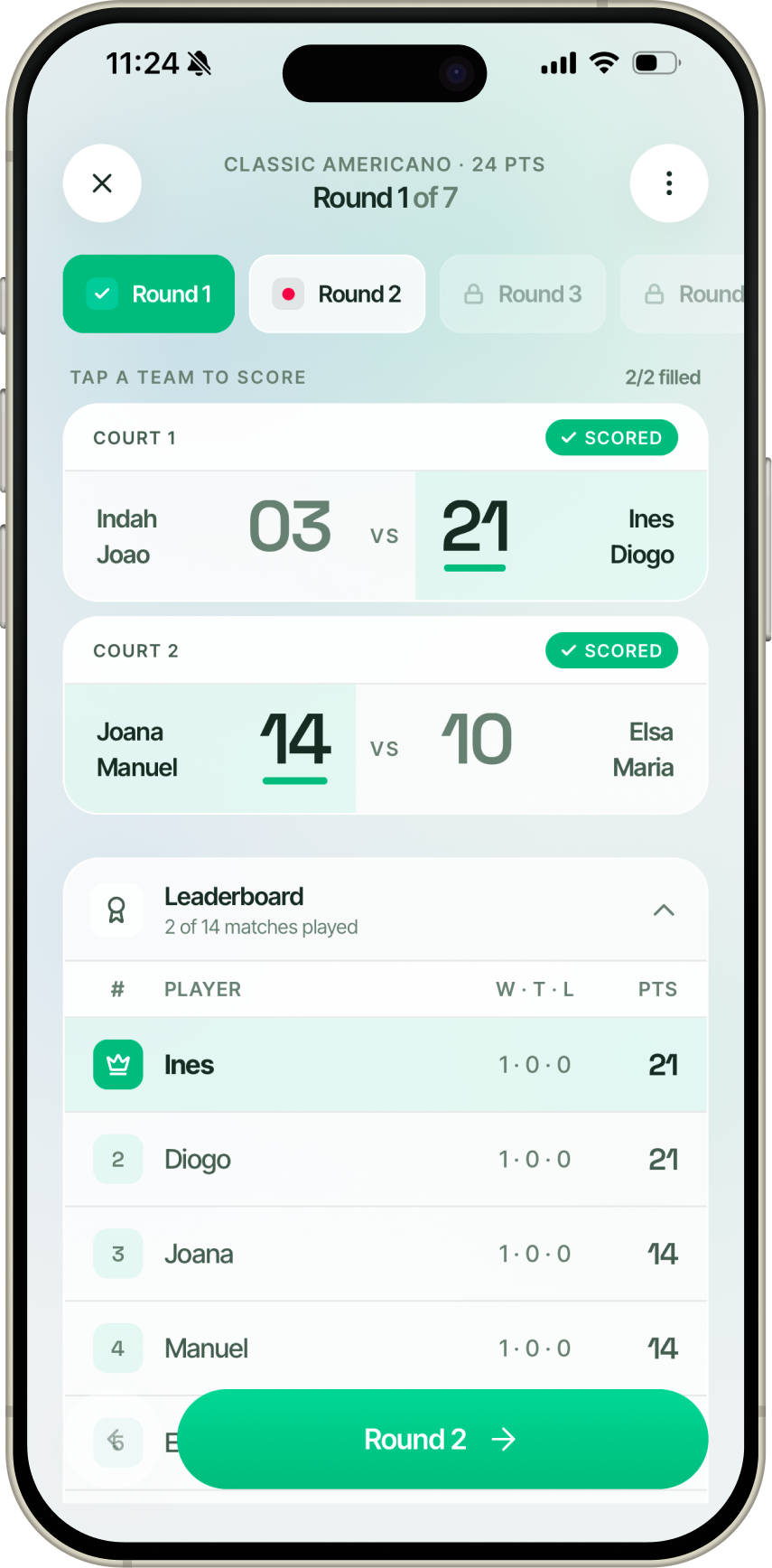
The first time someone plays an Americano, the scoring confuses them. There are no sets. There are no games. Nobody says “40-30”. You play to 24 points, the match ends, and both teams walk away with a number.
Then they lose 15-9 and are told they just earned 9 points, which sounds like a consolation prize.
It is not. It is the entire reason the format works.
What actually gets counted
In an Americano, every point scored goes onto the individual total of both players who scored it. Not the team’s. Not the winner’s. Yours.
Play to 24 and lose 15-9, and your total goes up by 9. Play the next round with a stronger partner, win 24-6, and your total goes up by 24. After six rounds you have a number that represents how many points you personally were on court for.
The player with the highest total at the end wins the day. Point difference breaks ties, then match wins.
Why not just count match wins?
Because in a format where your partner changes every round, match wins measure your partners more than they measure you.
Consider two players in an 8-person Americano. Both are equally good. One happens to be drawn with the three strongest players in rounds one to three; the other draws the three weakest. Under a win-count system, the first player is 3-0 and the second is 0-3, and the standings are describing the draw, not the players.
Points fix this because they are continuous rather than binary. Losing 13-11 with a weak partner registers as a strong performance. Winning 24-4 with a strong one registers as a stronger one. The signal survives the rotation, and after enough rounds the draw luck averages out.
Why the target is fixed
Both team scores in an Americano always add up to the same number. Play to 24 and every result is 24-0, 23-1, 22-2, and so on. That is deliberate: it means every round hands out exactly the same number of points to the court, so a player who happens to be on a court that finished quickly is not disadvantaged against one whose match went long.
It also makes the maths trivial. Six rounds to 24 means a theoretical maximum of 144, and every player’s total is directly comparable to every other’s.
The one thing organisers must say out loud
The scoring only works if people keep playing when the match is gone.
If a pair is 20-4 down and decides the round is over, they stop earning, and they also hand the other pair four cheap points that distort the standings. Both halves of that are bad.
So say this before round one, in these words:
Every point you score counts for you, even in a match you lose. Play out every rally.
It takes five seconds and it is the difference between a real leaderboard and a decorative one.
What this means for close finishes
Because points accumulate rather than reset, Americano standings are usually tight and rarely settled early. A player sitting fourth going into the final round can win it with one strong match, which keeps the last round of the night meaningful for far more of the field than a bracket would.
That is also why the tiebreakers matter. Two players on 118 points is a genuinely common outcome, which is when point difference (points scored minus points conceded across your rounds) decides it.
The same logic, applied differently
Mexicano uses identical scoring but feeds the standings straight back into the draw: after each round players are re-sorted by total points and re-paired by rank. Same numbers, different job. In an Americano the points only decide the winner; in a Mexicano they also decide who you play next.
Full rules, tiebreakers and a worked example schedule are on the Classic Americano page.