King of the Court padel: rules and how to run it
King of the Court padel explained: how the court ladder works, timed rounds, scoring, common variations and tips, plus how it compares with Mexicano.

King of the Court padel is the social format with a throne. The courts are ranked, the top one is the king court, and after every round the winners move up a court while the losers move down. Nobody is knocked out, and everybody can see exactly where they stand: it is the court they are standing on.
There is no official rulebook, so clubs run it in slightly different ways. Here is the common core, the main variations, and how to run one without arguments.
How King of the Court works
Number your courts from 1, the king court, down to the bottom court. Put two pairs on each. Then play timed rounds, with every court starting and stopping together. When time is up:
- King court: the winners stay. The losers drop to court 2.
- Middle courts: the winners move up one court and the losers move down one.
- Bottom court: the winners move up. The losers stay where they are.
A pair that starts on the bottom of four courts needs three straight wins to reach the king court, and a single loss up there sends them back to court 2.
The idea travels under several names. In Spain it is a pozo or rey de la pista, in France a montante-descendante, and some clubs sell it as King of the Hill or Winners Court. Club booking software has started listing it as a tournament format alongside Americano and Mexicano.
Setting it up
Players and courts
You need exactly two pairs per court: 8 players for two courts, 12 for three, 16 for four. Two courts is the minimum for a ladder to mean anything, and three or four is where it gets interesting.
Spare players are the format’s weak spot, because every court needs four. If you have an extra pair, run a queue at the bottom: the losing pair on the bottom court sits out a round and the waiting pair comes on.
Starting positions
Round 1 can be random, or seeded with the strongest pairs at the top so the early rounds are competitive straight away. A random start turns the first few rounds into a sorting exercise.
Round length
Timed rounds suit this format, because nobody can move until every court has finished. Rounds of about 15 to 20 minutes are common. As a guide, 16 players on four courts can fit six rounds of 15 minutes into a two-hour booking, with time left for the briefing and changeovers.
Rules and scoring
When time is up
Use one horn or whistle for every court. Decide in advance whether the point in play can finish. After that, the score stands, even if it is a one-point lead.
If a match is level, play one deciding point, the way golden point works in normal padel scoring: the receiving pair chooses who receives. Every court needs a winner, or nobody knows where to go next.
Within a round, count either games, with golden point at deuce, or rally points as in an Americano. Points are quicker to track and stop one long deuce game from eating the round.
Who wins
This varies most between clubs, so say which rule you are using in the briefing:
- Last pair standing: whoever wins on the king court in the final round is king. Simple and dramatic.
- Court points: with three courts, a win scores 3 on court 1, 2 on court 2 and 1 on court 3. This rewards a whole evening near the top, not one good last round.
- Games won: everyone keeps a running total of games or points won, and the highest total wins.
Common variations
Fixed pairs or split partners. In the classic version, pairs enter together and climb together. In the split version, every pair breaks up after each round, and each player partners someone who came from a different court. Tennis clubs call this up and down the river. It is more social, and the king court becomes an individual title.
Winners stay on. With one court and a crowd, King of the Court becomes a queue: the winning pair stays on, the losers go to the back of the line, and the next pair steps on. Games are short, often a race to a handful of points, so the queue keeps moving.
Tips for a smooth night
- Label the courts. A number on every court and “King” on court 1 saves a lot of pointing.
- Write the rule where everyone can see it. Winners up, losers down, and a level score at the horn means one deciding point.
- Keep a simple sheet. Note who finished where each round. It settles disputes in seconds, and at the end it is your results.
- Keep levels reasonably close. With a wide spread, the same pairs sit on the bottom court all night. For a very mixed group, our comparison of padel tournament formats has kinder options.
King of the Court vs Mexicano
Both formats push the strongest players together as the night goes on, and neither eliminates anyone. The machinery is different.
| King of the Court | Mexicano | |
|---|---|---|
| What moves you | Winning or losing | Your total points |
| Narrow win vs big win | Same move either way | Big win is worth more |
| Movement per round | One court at a time | Can climb several places |
| Partners | Fixed or split | Set by rank each round |
| Final result | A king, or court points | A full ranking |
In a Mexicano, players are re-sorted by total points after every round and grouped in fours by rank, with the 1st and 3rd playing the 2nd and 4th. The standings, not the court number, decide who plays whom.
So King of the Court is about the moment: one bad round on the king court and you are back on court 2. Mexicano is about the whole evening: a bad round costs you points, but the standings remember every other round too. Pick King of the Court for drama, and Mexicano for a final ranking that is fair to everyone’s night. Americano vs Mexicano compares it with the other big social format.
Running it with PadelEasy
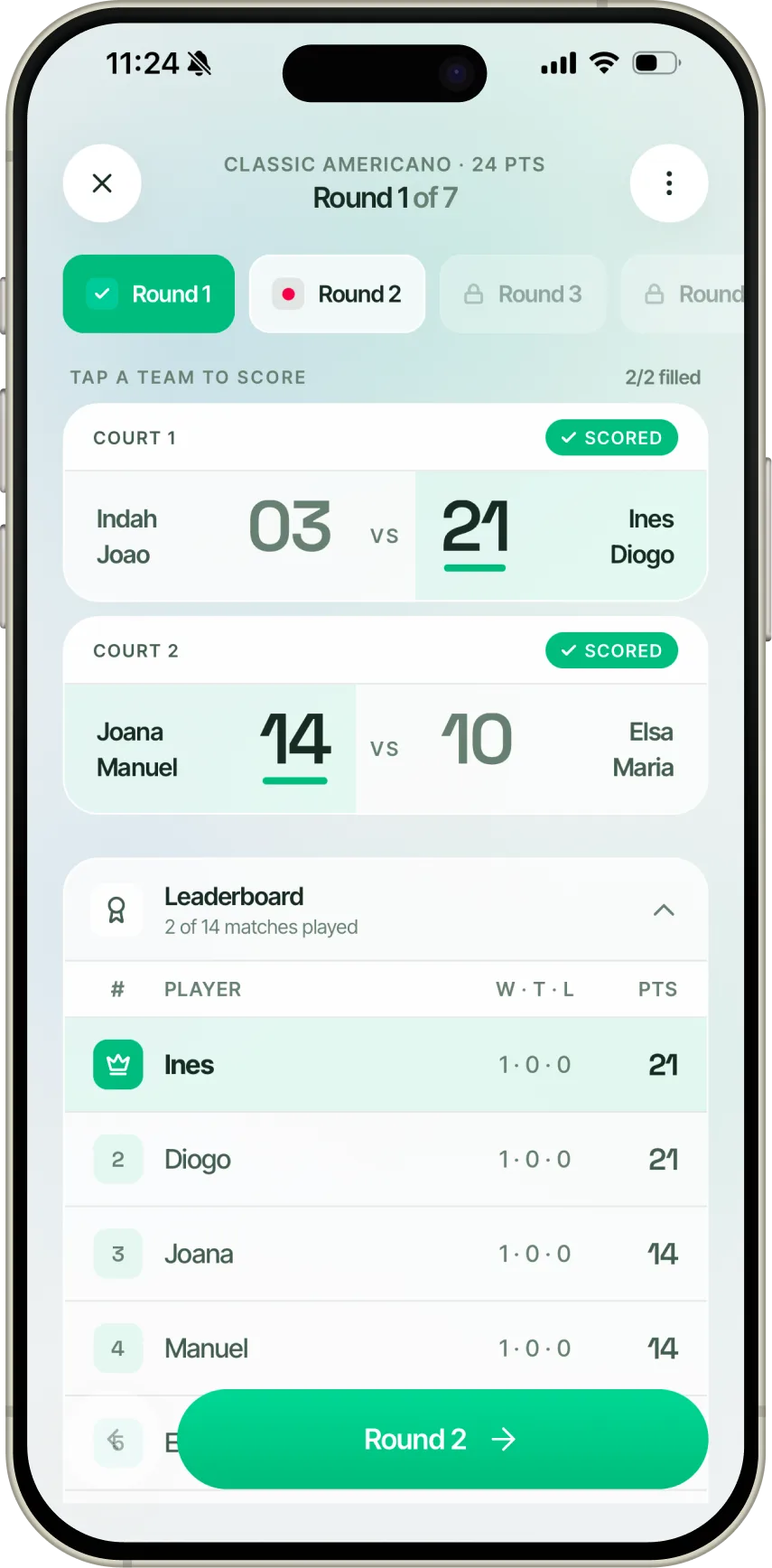
PadelEasy runs King of the Court as two ladder formats. Up and Down is the split version: winners move up a court, losers move down, and the pairs arriving on each court split up, so nobody keeps last round’s partner. Team Up and Down is the classic version, with fixed pairs climbing together. Both fill every court, so you need a multiple of 4 players, or an even number of teams.
- Play timed matches. The app runs one countdown for the round, from 5 to 60 minutes, so every court plays to the same clock.
- Level scores get a winner. If a match ends level, the app asks who won the deciding point, and that side moves up.
- Crown the winner your way. By default the winners on court 1 in the last round finish on top. You can switch the standings to total points or matches won at any time, without moving anyone.
- Put the standings on a screen. The live link opens in any browser with no login or install, so the club TV can show who is on top.
For a slower ladder, Beat the Box keeps players in boxes of four for three rounds at a time, then moves them up or down by results. If this is part of a regular social, our guide to running a padel club night covers the rest of the evening. Download PadelEasy to run King of the Court at your next session.
Frequently asked questions
How many players do you need for King of the Court?
Four per court, in two pairs. The ladder version needs at least two courts, so 8 players is the minimum. Twelve to 16 players on three or four courts gives the ladder room to work.
Who wins King of the Court?
It depends on the version: the pair that wins on the king court in the last round, or whoever has the most court points or games. Announce the rule before you start.
Can PadelEasy run King of the Court?
Yes. Up and Down runs it with a new partner every round, and Team Up and Down with fixed pairs. The app moves everyone between courts as soon as the scores are in.