Padel tournament formats compared: which one should you run?
Padel tournament formats compared: Americano, Mexicano, round robin, knockout, groups, King of the Court and leagues, with player counts and timings.

Padel tournament formats all answer the same two questions: who plays with whom, and how is the winner decided? Pick the answers that suit your group and the day runs itself. Pick badly and you get beginners knocked out after one match, or regulars bored by lopsided games.
These are the main types of padel tournaments that clubs and organisers run, with what each is good for, how many players it needs and how long it takes. PadelEasy runs two of these families, Americano and Mexicano, in eight versions between them. The others are here so you can choose with the full picture.
The formats at a glance
| Format | Entry | Players | Rough time | Best for |
|---|---|---|---|---|
| Americano | Individuals | 4 or more | 2 hours for 8 | Mixed-level socials |
| Mexicano | Individuals | 4 or more | Any length | Competitive socials |
| Round robin | Pairs | 4 to 6 pairs | 3+ hours | Guaranteed matches |
| Knockout | Pairs | 8 to 32 pairs | 3+ hours | A clear champion |
| Groups + knockout | Pairs | 8 to 32 pairs | About 6 hours | Club championships |
| King of the Court | Either | 4 per court | 1.5 to 3 hours | Lively socials |
| Box league or ladder | Either | Any | Weeks | Season-long play |
Times for the pair formats assume one-set matches of about 40 minutes, on 3 courts for 6 pairs and 4 courts for 16 pairs.
Americano
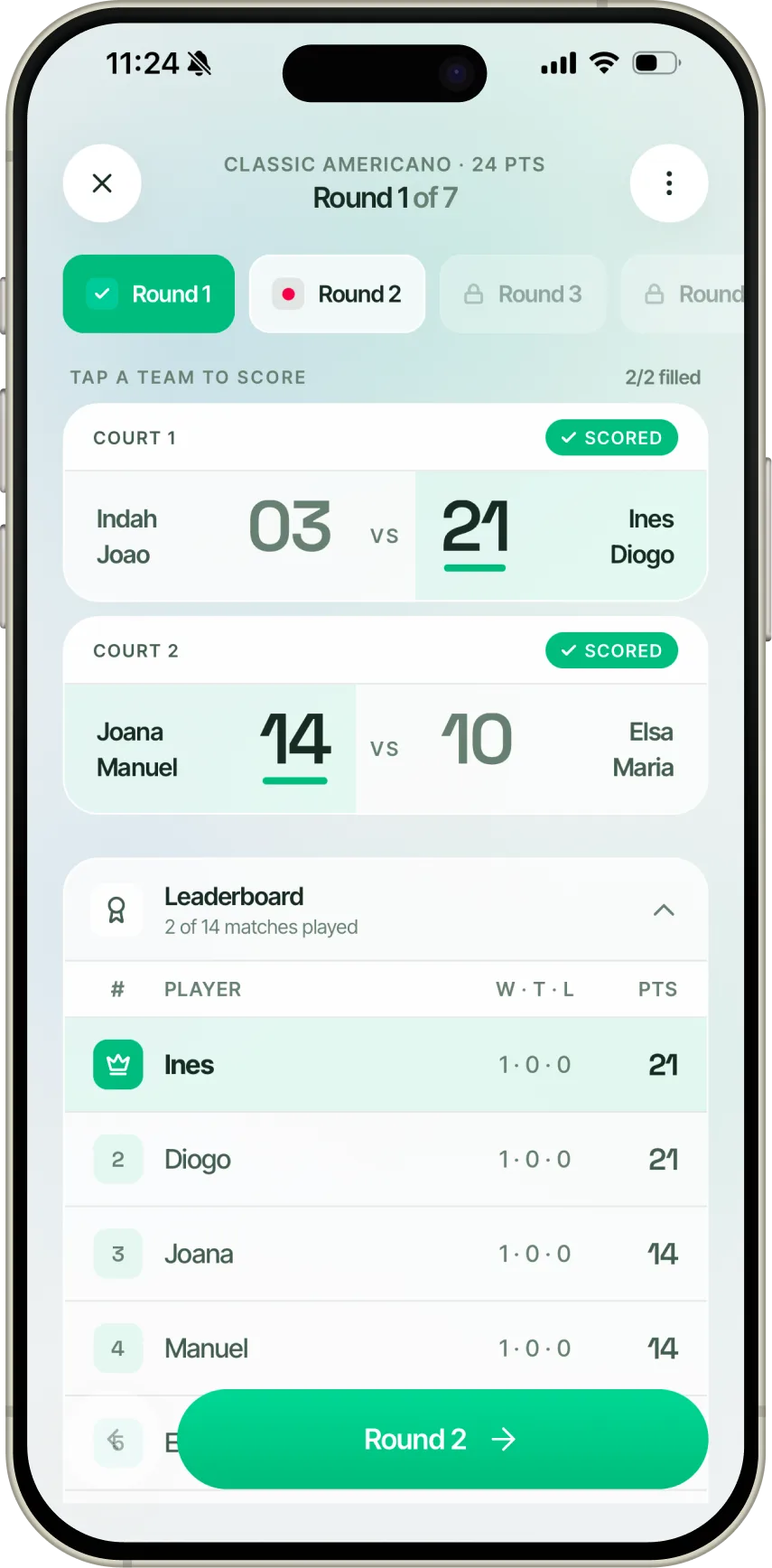
Players enter alone. Before the first serve, the whole schedule is drawn so that partners rotate every round and opponents are spread out. Matches run to a points target, usually 16, 24 or 32, and every point you score goes on your personal total, even in a match you lose. The highest total wins.
It comes in four versions: Classic (anyone can partner anyone), Mixed (every pair is one man and one woman), Team (fixed pairs play a round robin and share a total) and Club (two clubs, partners from your own side, opponents from the other).
- Best for: social nights, mixed levels and groups that change week to week.
- Players: 4 or more. With 8 on 2 courts, everyone partners everyone else exactly once in 7 rounds.
- Time: a round to 24 points takes 12 to 15 minutes, so that 8-player rotation takes about 2 hours.
- Pros: a fair draw, easy to explain, a known finish time, and nobody is eliminated.
- Cons: with a wide level gap some matches are lopsided, and there is less tension at the top than in a Mexicano.
Rules and an example schedule are in the Classic Americano guide.
Mexicano
Also individual entry and points scoring, but nothing is drawn upfront. Round 1 is random. After that, players are sorted by total points, split into groups of four in rank order, and within each group the 1st and 3rd play the 2nd and 4th. Some organisers pair 1st with 4th instead; the idea is the same. Win well and you climb into harder company. Have a bad round and you drop towards players at your current level.
It has the same four versions. In Team Mexicano, fixed pairs play the team next to them in the standings each round.
- Best for: competitive groups of similar level who want close matches.
- Players: 4 or more.
- Time: open-ended. There is no fixed number of rounds, so it fills whatever court time you have.
- Pros: matches get closer as the night goes on, and it is easy to add a round.
- Cons: each round depends on the last scores, so there is no schedule to print, and the strongest players rarely partner the weakest.
The Classic Mexicano guide has a worked example, and Americano vs Mexicano helps you choose between the two. All eight versions are on the formats page.
Round robin
Fixed pairs, and every pair plays every other pair once. Matches are normally scored in games, one set or a short set, often with golden point at deuce. The table usually ranks pairs by matches won, then by games won minus games lost.
The catch is the maths. Four pairs play 6 matches, six pairs play 15 and eight pairs play 28. Past six pairs, split the field into groups.
PadelEasy’s Team Americano is a round robin for fixed pairs, scored by points: every team plays every other team once. It runs one round robin for the whole field, though. It does not split you into groups or score games and sets.
- Best for: pairs who entered together and want guaranteed matches.
- Players: 4 to 6 pairs per group.
- Time: 6 pairs on 3 courts need 5 rounds. At 40 minutes a round, that is over 3 hours.
- Pros: everyone plays the same number of matches, and the final table is hard to argue with.
- Cons: big fields take far too long, and the last matches can be dead rubbers.
Knockout bracket
The pro-tour shape. Pairs are seeded into a bracket, and if you lose, you are out. Brackets work in powers of two, so with 12 entries you draw a bracket of 16 and give the top four seeds a bye.
A knockout needs one match fewer than it has entries: 16 pairs play 15 matches over 4 rounds. That makes it efficient, but half the field is finished after one match. The fix is a consolation draw, where first-round losers play on. In the UK, the LTA’s sanctioned padel tournaments use elimination draws with consolation, or compass draws. In an 8-pair compass draw, every pair plays three matches whatever their results.
- Best for: competitive events that want a final and a champion.
- Players: 8, 16 or 32 pairs, or anything in between with byes.
- Time: 16 pairs on 4 courts need 5 slots. With one-set matches, that is over 3 hours.
- Pros: real drama, a clear winner and the fewest matches of any pairs format.
- Cons: early losers barely play, courts empty as the draw thins, and seeding decides a lot.
Groups plus knockout
A common shape for club championships. Pairs play a round robin in small groups, then the top one or two from each group go into a knockout. With 16 pairs in four groups of four and the top two going through, you get quarter-finals, semi-finals and a final: 31 matches in all.
Seed the groups so the strongest pairs are spread out. Seeds 1 to 4 head groups A to D, and the next four go in reverse order, D to A.
- Best for: fixed-pair tournaments that want guaranteed matches and a proper final.
- Players: 8 to 32 pairs.
- Time: the 16-pair example needs 9 slots on 4 courts, around 6 hours with one-set matches.
- Pros: in groups of four, every pair plays at least three matches, and the final still means something.
- Cons: it is long, level groups need clear tie-break rules, and some last group matches decide nothing.
King of the Court
The courts are ranked, court 1 is the king court, and rounds are timed so every court finishes together. Winners move up a court and losers move down, except that the winners on court 1 stay put and so do the losers on the bottom court. Some clubs keep pairs fixed, others split them after every round, and the winner is either whoever holds the king court at the end or whoever collects the most points. The rules and variations are in our guide to King of the Court padel.
- Best for: lively socials where players want to chase the top court.
- Players: 4 per court, on at least 2 courts. Three or four courts work better.
- Time: 90 minutes to 3 hours, in rounds of about 15 to 20 minutes.
- Pros: every round has something riding on it, and there is no maths between rounds.
- Cons: a narrow win moves you the same as a big one, level matches need a deciding point, and weaker pairs can spend the night on the bottom court.
PadelEasy does not run King of the Court. A Mexicano is the closest option in the app.
Box leagues and ladders
These are not one-day tournaments but competitions that run over weeks.
In a box league, players or pairs are grouped into boxes of four to six by level. Everyone in a box plays everyone else over a set period, often a month or two, arranging their own court times. At the end, the top of each box moves up a box and the bottom moves down.
A ladder is a ranked list. You challenge a pair a few places above you, and if you win, you take their place. Clubs set their own rules; one we looked at allows challenges up to three places above you, with 48 hours to accept and 10 days to play.
- Best for: members who want regular competitive matches without a fixed night.
- Players: any number.
- Time: weeks per cycle.
- Pros: levels sort themselves out, and players always have a next match.
- Cons: someone has to chase results, and some matches never get played.
PadelEasy runs single sessions, not leagues across weeks. For the admin side, see how to run a padel league.
Frequently asked questions
What is the best padel tournament format for a social?
An Americano. Everyone plays every round, levels mix and the finish time is fixed. Switch to a Mexicano when the group is competitive and close in level.
Which formats suit fixed pairs?
Round robins, knockouts, groups plus a knockout, and the fixed-pair version of King of the Court. If you would rather score by points than sets, Team Americano and Team Mexicano keep pairs together too.
What format do official padel tournaments use?
Mostly knockout draws. In the UK, the LTA’s sanctioned events use elimination draws with consolation or compass draws, with a round robin option at Grade 3.
How do you plan a day around a format?
Start from your group and your court time, then work out the rounds. Our step-by-step guide to organising a padel tournament covers the maths.