Padel levels explained: what your rating really means
Padel levels explained: how the Playtomic 0 to 7 scale works, what a level 3.5 player can actually do, and how organisers use levels to group players.

Ask a padel player how good they are and you will often get a number instead of a description. Padel levels have become the shared language of the sport: they often decide which open matches you can join, which socials you get invited to and who you end up partnering. Many of those numbers come from one place, the Playtomic app.
The number is useful, but it is easy to read too much into it. Here is how the scale works, what each band looks like on court, and how organisers can use levels without letting them run the evening.
How the Playtomic scale works
Playtomic rates players from 0 to 7. At the bottom is someone who has never played a racket sport. At the top are professionals.
You get your first number from a short questionnaire about your experience and ability when you sign up, and you can only fill it in once. After that, a match only moves your Playtomic level if it is marked as competitive in the app. Casual matches do not count, and neither does anything you play outside it.
The score also has to look like a real set. Playtomic only counts sets where someone reached 6 or 7 games with a proper margin, so 6-4 and 7-6 count, but 6-5 does not.
How your level moves
After each competitive match, the algorithm works out each team’s average level, compares the result with what those levels predicted, and adjusts every player. Playtomic’s help centre lists four things that decide how far you move:
- The result. Win and you go up. Lose and you go down.
- Your opponents. Beating a stronger pair lifts you more than beating an equal one. Losing to a weaker pair costs more.
- Your partner. A win alongside a much stronger partner was expected, so it earns less.
- Your reliability. A percentage showing how sure the system is about your level. It grows as you play competitive matches. Low reliability means big swings; high reliability means small ones.
Reliability is why you and your partner can move by different amounts after the same match, and why a new player’s number jumps around before it settles. A settled level moves slowly: Playtomic’s own help pages use +0.04 as an example of a single match’s change. Even a draw moves things, with the stronger team losing a little and the weaker team gaining.
If your number is clearly wrong, you have options. You can lower it yourself in the app, but you cannot simply undo that; the level has to be earned back. Consistently positive reviews from opponents can unlock a self-upgrade of up to 0.5. Or you can book a levelling session with a coach at a certified club, which sets your level and puts your reliability at 50%.
The weak spot is the starting point. The questionnaire is self-assessed, and a common complaint is that it places people too high, which then takes a run of losses to correct. The other trap is a closed group. If you play the same three friends every week, your level mostly measures you against them.
What each level looks like
Playtomic publishes its own description for each band, and the wording has been revised over time. This is our plain-language version of what a typical player at each level can do. Treat the edges as soft: a 2.9 and a 3.1 are the same player on a different day.
| Level | Stage | What a typical player can do |
|---|---|---|
| 0 to 1 | First sessions | Learning the serve and where to stand. Rallies are short and the back glass is a mystery. |
| 1 to 2 | Beginner | Rallies at a gentle pace. Most points end on an error, and the walls get used by accident. |
| 2 to 3 | Improver | Controls direction at a normal pace, volleys, and starts letting the ball come off the back glass. Plenty of unforced errors. |
| 3 to 4 | Club intermediate | Consistent rallies, plays most balls off the glass, lobs on purpose and mixes slice with flat shots. Errors creep in when the pace rises. |
| 4 to 5 | Strong club player | Few unforced errors, switches between defence and attack, and hits with real pace. Finishing points is the missing piece. |
| 5 to 6 | Advanced | Strong technique and tactics, plays tournaments, finishes points and holds up under pressure. |
| 6 to 7 | Elite | High-level competitive players. The very top of the scale is for professionals. |
If you are in the first two rows, our padel guide for beginners covers what to work on first.
What a 3.5 really means
A padel level 3.5 sits right in the middle of club padel. It describes a capable player: not a beginner, not yet a strong one. A typical 3.5:
- keeps a rally going at a steady pace without gifting points,
- returns most balls that come off the back glass,
- lobs deliberately to push the opponents away from the net,
- volleys with control and hits slice as well as flat,
- moves with their partner instead of chasing the ball alone.
What separates a 3.5 from a 4.5 is mostly errors and pace. The 4.5 makes far fewer mistakes, can speed the ball up when the chance comes, and has a dependable overhead such as the bandeja. Our guide to the main padel shots explains what each one is for.
Two cautions. A 3.5 on Playtomic is not automatically a 3.5 on another scale, even one that also runs to 7. And numbers can drift between clubs and regions, because every level is earned against the players around you.
Other rating systems
Playtomic is the number many club players know, but it is not the only one.
- LTA Padel rating. In Britain, the LTA uses a rating from 1.0 to 7.0 in half-point steps, which you choose from written descriptions. At 3.0, for example, a player is fairly consistent and can use the wall tactically. It is a separate scale from Playtomic’s, so the same number does not necessarily mean the same standard.
- Federation rankings. A ranking is not a rating. It is points earned in sanctioned tournaments over a rolling year. The LTA’s padel ranking counts your best six results from the last 52 weeks, and the professional FIP Ranking counts a player’s best 22 results from Premier Padel and the CUPRA FIP Tour. A ranking tells you what someone has achieved in competition, not how they will play at your Tuesday social.
- Tournament categories. Spain and Argentina split amateur tournaments into numbered categories, and first category is the strongest.
- Club groups. Many clubs sort members into A, B, C and D groups for leagues and socials. These are local labels: a B player at one club can be a C somewhere else.
How organisers use levels
For an organiser, a level is a sorting tool. Its job is to get the right four people onto the same court.
Level-banded sessions
Set a range, such as 2.0 to 3.0, and put it in the invite. Playtomic’s open matches work the same way: each match has a level range, and players outside it have to request a place.
Splitting one big group
With 16 players and a wide spread, sort by level and run two separate Americanos of eight, each on two courts. As a rough rule, a single Americano copes comfortably with about a point of spread, say 2.5 to 3.5. Much wider than that, and the rounds where two beginners face two strong players are long for everyone on court.
Letting Mexicano do the sorting
A level is an estimate of how someone usually plays. A Mexicano measures how they are playing tonight.
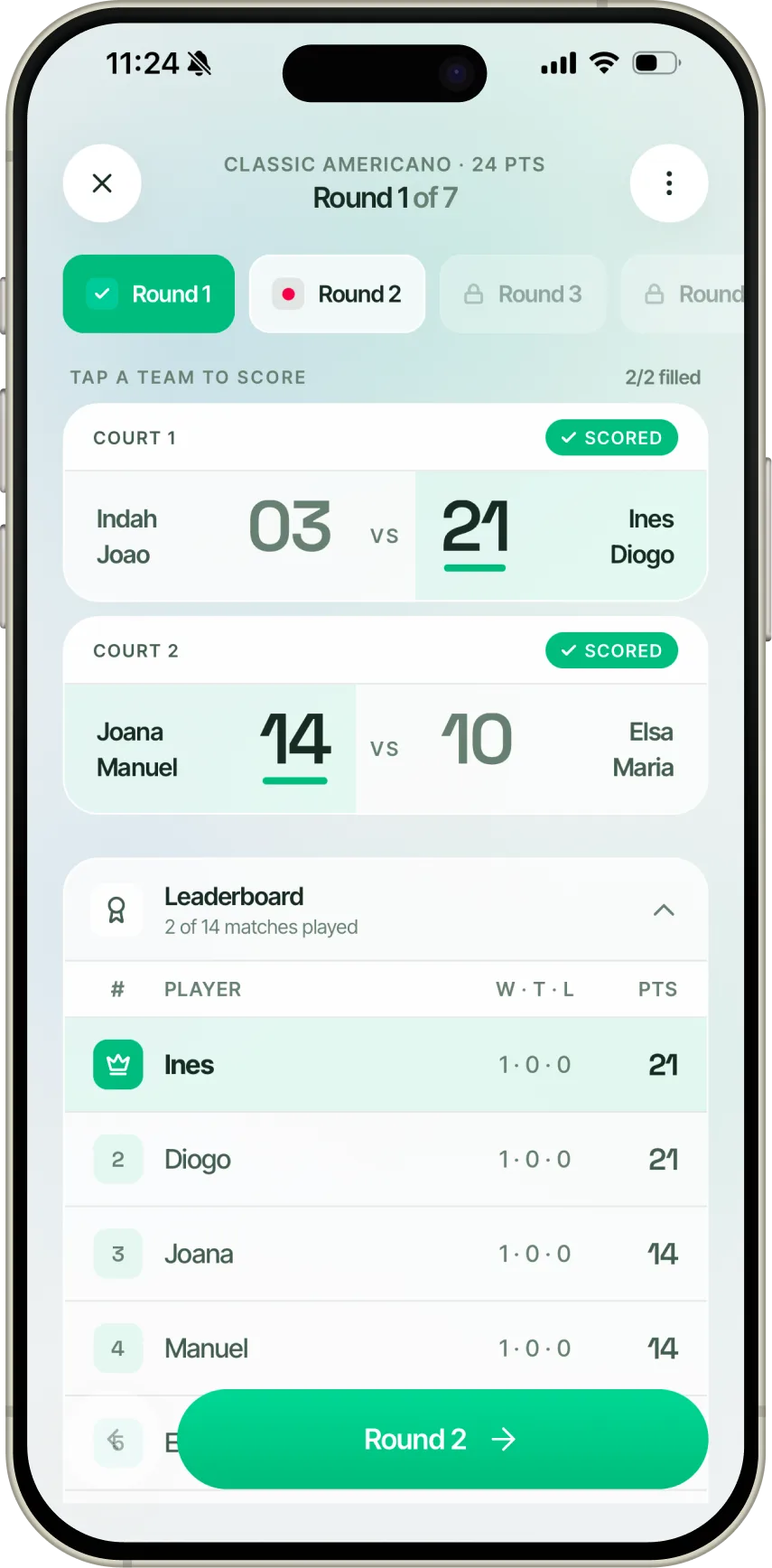
Round one is drawn at random. After that, players are ranked by total points, split into groups of four in rank order, and in each group 1st and 3rd play 2nd and 4th. Win and you climb into stronger company. Have a bad round and you drop to players on your current form. By round three or four the courts have usually sorted themselves, and the top four are playing the closest match of the night.
That makes Mexicano the easiest answer when half the group has no rating, or when someone’s number is a year out of date. PadelEasy redraws each Mexicano round from the live standings, so nobody has to rank players by hand. It does not read Playtomic levels: importing a Playtomic tournament link brings in the player names only. If you are still choosing a format, Americano vs Mexicano compares the two.
Frequently asked questions
What is a good padel level?
Whatever gets you close, enjoyable matches. As a guide, 2 to 3 is a solid improver, 3 to 4 a capable club player, and above 5 you are usually playing tournaments.
Why did my partner’s level change more than mine?
Mostly reliability. A player with lower reliability moves further after the same result, so a newer partner swings more than you do. Each player’s own level against the opponents plays a part too.
Does a social Americano change my Playtomic level?
Only competitive matches recorded in Playtomic with a valid set score count. A points-based night run in another app, PadelEasy included, has no effect on it.
Can I lower my Playtomic level?
Yes, for padel, from your profile in the app. You cannot simply change it back afterwards: it has to come back through competitive matches, a levelling session or the self-upgrade feature.