Padel etiquette: the unwritten rules on court
Padel etiquette is mostly common sense, plus a few habits specific to padel: who calls the fence, net cords, passing balls, changing ends and mixed play.

Most padel is played without an umpire, between people who would like to be invited back next week. That is what padel etiquette is for. None of it is complicated, but some of it is specific to padel: who calls a ball that hits the fence, why you raise a hand after a net cord, and why you never open a court door in the middle of a rally.
Here are the unwritten rules, in roughly the order you meet them on a normal evening. If you are brand new to the game, start with our guide to padel for beginners.
Arriving and warming up
Aim to arrive 10 to 15 minutes before your slot, so you are changed and on court when the booking starts. Four people share that time, so arriving ten minutes late costs everyone ten minutes.
The warm-up is cooperative. Hit the ball to people, not past them, at a pace everyone can rally at. A simple routine:
- One pair at the net volleying, the other at the back hitting groundstrokes.
- Swap roles after a few minutes.
- Finish with a few lobs so everyone hits some overheads, and a couple of practice serves each.
Do not smash winners in the warm-up. It wins nothing and annoys everyone.
Spinning for serve and ends
The official rules settle serve and ends with a coin toss. At club level a spun racket does the same job: one player spins it, and someone from the other pair calls “up” or “down”, usually for the logo on the end of the handle.
The winners pick one thing: to serve or receive first, or which end to start at. The other pair gets the remaining choice. The winners can also hand the first pick to the other pair.
Then change ends after the first game and every two games after that (after games 1, 3, 5 and so on), and every six points in a tie-break. Outdoors it shares out the sun and wind, so do it even in a casual game. Keep changeovers short: a drink, a towel, back on court.
Calling the score
The server calls the score before every serve, server’s score first, loud enough for all four players to hear. It takes a second and saves the argument about whether it is 30-40 or 40-30.
Two more habits:
- Agree what happens at 40-40 before the first point: advantage, a single golden point, or the newer star point. Our guide to padel scoring explains the options at deuce.
- Serve when the receiver is ready, and do not keep the server waiting when you are receiving.
If the score gets muddled, go back to the last score all four of you agree on and play on from there.
Making your own calls
Padel has very few lines, and they only matter on the serve. Everything else is about bounces, walls and the fence, and without an umpire each pair calls its own side of the net.
- The serve. The receiving pair calls it. A serve that lands outside the box is a fault, and so is one that bounces in and then hits the metal fence.
- Your own faults. Call them straight away, without waiting to see if anyone noticed: a double bounce, a ball that touched you or your clothes, your racket touching the net, or your shot hitting the fence on your side.
- Close calls. If you did not see it clearly, you cannot call it. Give your opponents the benefit of the doubt, or offer to replay the point.
If you are not sure what the rules actually say, our padel rules guide covers them, and the full text is in the International Padel Federation’s official rules.
Net cords and frame shots
Win a point off the net cord or the frame of your racket and you raise a hand and say sorry. Nobody thinks you meant it. The gesture just acknowledges that the point was lucky, and it costs nothing.
The same goes for a ball that dies in the fence or catches the join between the glass and the mesh. And if you hit someone with the ball, check they are all right before anything else.
Never celebrate an opponent’s mistake. A fist pump for your own great shot is fine. One for their double fault is not.
Balls and neighbouring courts
Keep the balls moving towards the server. Between points, collect the balls on your side and send them over with a gentle bounce or roll. Do not hit them hard over the net at someone: the official rules treat that as ball abuse.
Clear loose balls off the court before the next point. A stray ball underfoot is an easy way to turn an ankle.
Courts are often side by side, so the manners extend to your neighbours:
- If a ball from another court rolls onto yours mid-point, call “let” and replay the point.
- Return their ball when their point is over, not in the middle of it.
- Do not walk behind a court, open its door or cross it during a rally. The players at the back are watching the ball come off the glass, right where you are walking. Wait for the point to finish.
Stronger or weaker partners
Social padel mixes levels all the time, and the partnership is where it shows.
If you are the stronger player:
- Do not take every ball. Your partner is paying for the court too.
- Do not coach mid-point. If your partner wants a tip, give one at the changeover, briefly.
- No sighing, no eye rolls, no “that was yours”.
If you are the weaker player:
- Apologise once, not after every point. Everyone misses.
- Take the balls you agreed to take, and call them clearly.
Against a weaker pair, playing to the weaker opponent is normal tactics in a competitive match. In a relaxed social game, share the ball around so all four people get a game.
Mixed padel etiquette
Mixed padel works best when everyone plays the ball, not the person. Treat every opponent as a player: going easy on someone because of their gender is patronising, and targeting them because of it is worse. Play the tactics you would play in any other game.
Two more points:
- In a social game, do not smash at anyone’s body from close range, whoever they are.
- Do not poach your partner’s balls. Hitting harder does not make every overhead yours.
The official rules add one mixed-specific detail: on a deciding point at deuce, the player receiving must be the same sex as the server. If you are organising a mixed night, our guide to mixed padel tournaments covers the formats.
Bookings and social events
Respect the booking at both ends. Do not walk on before your slot starts, and when your time is up, finish the point and leave: the next group has paid for their full slot. Take your balls, tubes and bottles with you.
Social events add a few rules of their own:
- Arrive for the briefing. It is where the organiser explains the format, the points target and how scores are reported.
- Tell the organiser early if you cannot make it. Every drop-out changes the draw for everyone else.
- Be on court when the round starts, and report your score accurately as soon as the match ends.
- Stay for the results. Someone put the evening together, and the final standings, the winner and the photo are part of it. If you have to leave early, tell the organiser in advance.
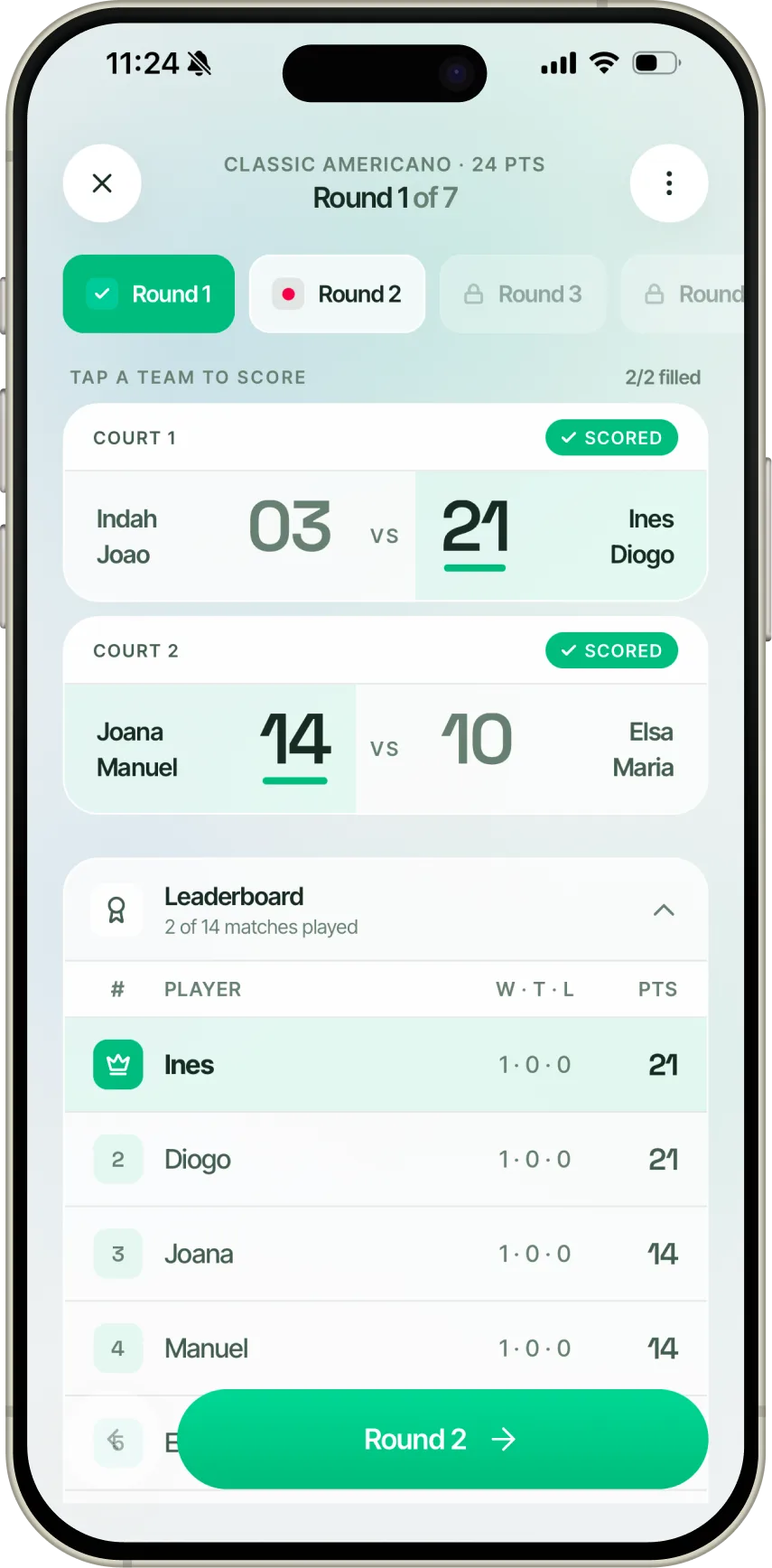
At a night run on PadelEasy, you can follow the live scores and standings from the organiser’s link or QR code, with no login or install.
And if you are the one organising, our guide to running a padel club night covers the other side of the net, and PadelEasy draws the rounds for you.