Padel for beginners: what to know before your first game
How to play padel from your very first booking: the kit you need, finding players, the basic rules, your first shots, the back glass and where to stand.

Padel is a racket sport for two pairs, played on a 20 by 10 metre court enclosed by glass walls and metal mesh. You score like tennis, but the ball can come off the walls like squash. This guide to padel for beginners covers everything to know before you step on court.
It is also quick to pick up: the court is small, the serve is underarm, and the walls give you a second chance at balls that get past you. Here is what to bring, how to find a court and three other players, the rules in brief, and how to play padel well enough to enjoy your first game.
What to bring
Less than you think. Most clubs hire out rackets, so for a first session the thing that matters most is your shoes.
- Racket. Padel rackets are solid, perforated and have no strings. Hire one for your first few sessions. When you buy, the LTA’s equipment guide points beginners to a round or teardrop shape for control and a foam core for a softer feel. Diamond shapes are built for power and suit attacking players.
- Wrist cord. Every padel racket has one, and the official rules make wearing it compulsory. Put it on before you hit a ball.
- Balls. Padel balls, not tennis balls. They look almost identical, but padel balls are slightly smaller and less pressurised, so they bounce lower and come off the glass slower. Agree who is bringing a new tube.
- Shoes. More important than the racket. Most courts are artificial grass dressed with sand, and a herringbone (zigzag) sole is the usual recommendation for it. Padel shoes are best, and clay-court tennis shoes are the closest alternative. Running shoes are a poor choice: they are made for running forwards, not for stopping and changing direction on sand. Some indoor venues ask for non-marking soles.
- Clothing. Any comfortable sports kit. Bring water, and a layer for outdoor courts in the evening.
Booking a court and finding players
A court takes four players and is usually booked in slots of 60 or 90 minutes. You can book through the club itself or through a booking app such as Playtomic, which many clubs use.
Finding the other three is harder. There are three good routes:
- Open matches. Booking apps let players post a game with spaces to fill. Pick one that is open to all levels or set at a beginner level, and join on your own.
- Beginner sessions. Group lessons and clinics put you on court with people at your level. Swap numbers with the ones you enjoy playing with.
- Social nights. Many clubs run sessions where you turn up alone and get mixed into games, often in an Americano format.
Be honest about your level when you join a game. Nobody minds a beginner in a beginners’ game. Our guide to padel levels explains what the numbers mean.
The rules in brief
Six rules will get you through your first game:
- Serve underarm. Stand behind the service line, bounce the ball and hit it at or below waist height, diagonally into the opposite service box. If it bounces in and then hits the metal fence, it is a fault. You get a second serve.
- One bounce, then the walls. The ball may bounce once on your side and come off the glass before you return it. It must not bounce twice.
- Your shot must bounce before it hits their walls. If it hits the opponents’ glass or fence on the full, you lose the point.
- You can use your own glass, not your own fence. Hitting the ball into your own glass so it rebounds over the net is legal. If your shot touches the mesh on your side, you lose the point.
- Do not touch the net, and do not let the ball touch you. Either one loses the point.
- Scoring is tennis scoring: 15, 30, 40, game. Six games wins a set if you are two games clear, with a tie-break at 6-6. At 40-40 some groups play advantage and others a single deciding point, so agree which before you start.
The full version is in our padel rules guide.
Grip and ready position
Use the continental grip for everything. Hold the racket with the edge of the frame pointing at the floor and shake hands with the handle, as if you were holding a hammer. It is the same grip tennis players use for volleys.
One grip for every shot means you never have to switch in a fast exchange at the net. Hold it lightly: a tight grip tires your forearm and kills your feel for the ball.
The ready position:
- Feet a little wider than your shoulders, knees soft, weight on the balls of your feet.
- Racket up in front of your chest, with your free hand resting on the throat of the racket.
- At the net, keep the racket head above the height of the net, so you are not lifting it for every volley.
The first shots to learn
Padel swings are short. You are guiding the ball to a target, not trying to hit it through the back glass.
Forehand and backhand
Turn side-on early, take a short backswing and meet the ball in front of your body, then push through it towards the target. A little slice, brushing slightly under the ball, keeps it low and awkward for players at the net.
Volley
At the net the volley is a block, not a swing. Keep the racket up, step towards the ball with your opposite foot and punch it deep into the other half. The pace comes from the incoming ball. Your job is direction.
Lob
The lob is the shot beginners forget and experienced players use all the time. When both opponents are at the net, open the racket face, swing from low to high and send the ball over them, to land beyond the service line and before the back glass. Cross-court gives you the most room. A good lob pushes them back, and your pair takes the net.
After these four come the overheads: the bandeja, the víbora and the smash. Our guide to padel shots explains them all.
Using the back glass
Every other racket sport has taught you to hit the ball before it gets past you. In padel, letting it go past is often the better play.
When a deep ball comes at you:
- Turn side-on and move back with it, leaving room between you and the glass.
- Let it bounce and come off the glass. The wall takes pace off the ball and gives you time.
- Step forward as it comes out and hit it on the way down, swinging from low to high.
- Play safe: a lob, or a steady ball back through the middle.
To practise, the LTA suggests having a friend feed you deep balls. Let each one bounce again on the court after it comes off the glass, then hit it. That extra bounce would lose the point in a match, but it buys you time to learn the angles. Once it feels easy, drop it.
Where to stand as a pair
In padel you attack and defend as a pair, and the pair moves together:
If your partner goes back, you go back. If your partner goes to the net, you go too.
One up and one back leaves a gap between you that any decent shot will find.
There are two good places to stand:
- At the back: about a step behind the service line, with room for the ball to come off the glass.
- At the net: roughly halfway between the net and the service line. Any closer and a simple lob beats you.
Everything in between is no man’s land, where the ball arrives at your feet and you have no good shot. Move through it; do not stop in it.
Balls down the middle are where pairs get confused, so agree a rule before you start. The usual one is that the player with the forehand in the middle takes it, which for two right-handers is the player on the left. Then call every shared ball early: “mine” or “yours”.
Common beginner mistakes
- Hitting too hard. A hard shot hits the back glass and comes straight back. Placement wins more points than pace.
- Rushing the ball before the glass. If it would come off the back wall at a comfortable height, let it.
- Smashing while moving backwards. Let a deep lob come off the glass and play it from there.
- Hugging the net. It feels aggressive, but it makes you easy to lob.
- Stopping in no man’s land. Be at the back or at the net.
- Never lobbing. When both opponents are at the net and you are under pressure, the lob is usually the right answer.
- Playing in silence. Two players leaving the same ball is an easy point to give away.
A few mistakes happen off the ball too, like walking behind a court mid-point. Our guide to padel etiquette covers the unwritten rules.
Lessons and Americano socials
A lesson or two early on saves months of guessing. A coach can fix your grip, show you how to read the glass and put you in the right place on court. Group beginner sessions do the same job and put you on court with people at your level.
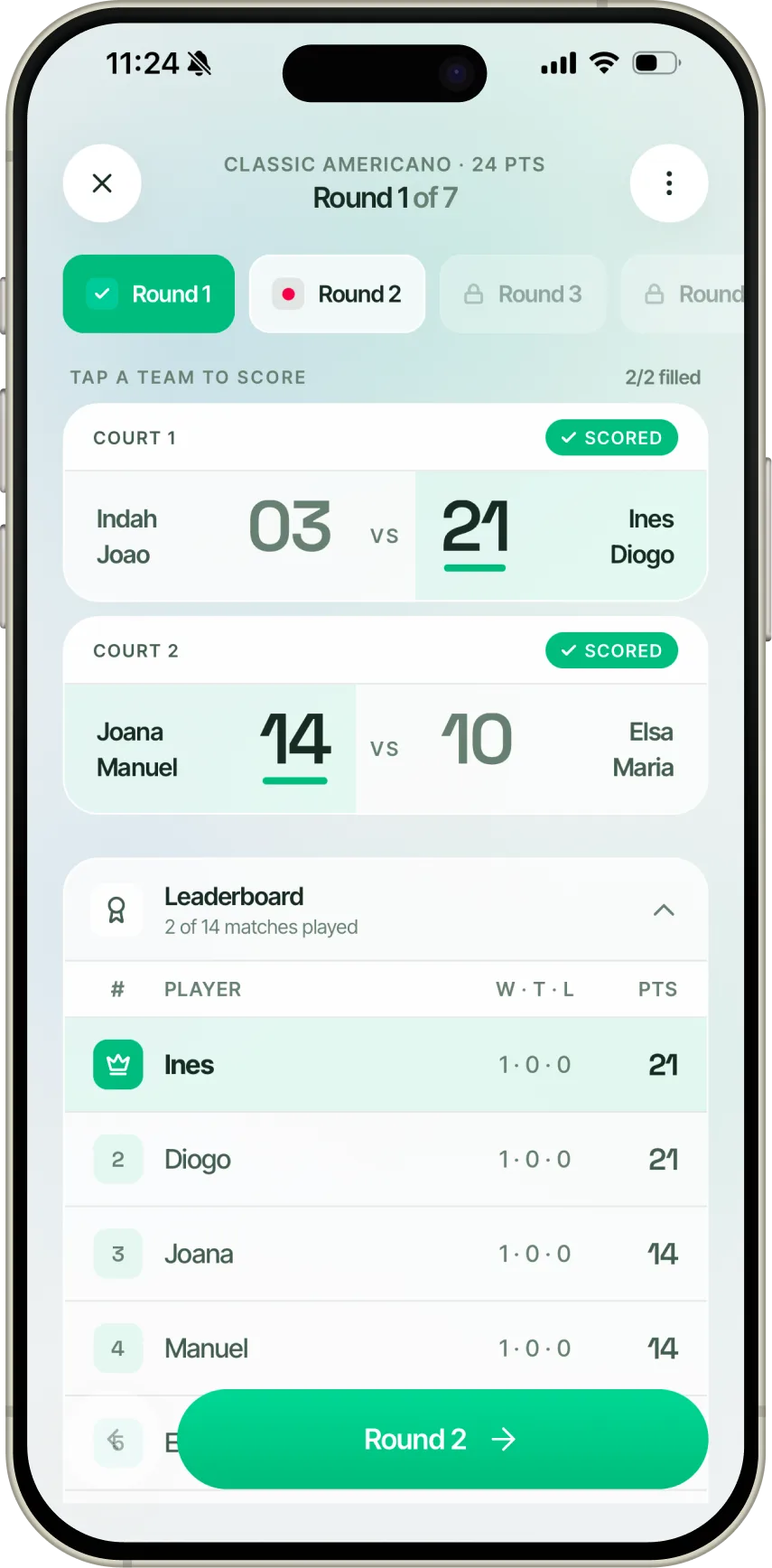
Then find an Americano. It is the classic padel social: you turn up on your own, get a new partner every round and play short matches to a points target. Every point you win goes on your own total, even in a match you lose, and nobody is knocked out. By the end of the evening you have partnered or played against most of the room, which makes it the easiest way to meet players at your level and fill your next booking. The Classic Americano page explains the format.
The organiser has the harder job: drawing rounds that keep partners, opponents and sit-outs fair. PadelEasy is what organisers use for that, and players follow the live scores and standings from a link or QR code, with nothing to install.
So book the court, borrow a racket, and let the glass do some of the work.