Padel rules explained: the complete beginner's guide
Padel rules for beginners in one place: the court, the serve, scoring, the walls, faults, lets and the net, plus what changes in an Americano.

Padel is easy to start and surprisingly easy to get slightly wrong. Most beginners pick up the basics in one session, then spend weeks unsure whether a ball off the fence was good, or whether they were allowed to reach over the net.
This guide covers the padel rules you will actually meet on court, in the order they come up: the court and kit, the serve, scoring, the walls, faults and lets, and the ways a point is lost. It follows the International Padel Federation’s Rules of Padel in the edition that applies from 1 January 2026. Where a topic deserves more than a few paragraphs, the section links to a deeper guide.
The court and equipment
The court
A padel court is 20 metres long and 10 metres wide (about 66 x 33 ft), fully enclosed, and split in half by a net that is 0.88 m high in the middle and 0.92 m at the posts.
Each half has a service line 6.95 m (about 23 ft) from the net, and a centre line that divides the space between the net and the service line into two service boxes. There are no sidelines or baselines to call. The walls are the edge of the court.
Those walls come in two materials, and the difference matters:
- Glass or solid wall. The back walls are 3 m high, with 1 m of metal mesh on top. The side walls are also solid for the first 4 m from each end.
- Mesh fencing. Fills the middle section of each side and sits on top of the back walls.
You will see why the distinction matters in the section on the walls. For the full measurements, see our guide to padel court dimensions.
Rackets and balls
Padel rackets are solid, with no strings. The face is perforated with holes, and the whole racket can be no longer than 45.5 cm (about 18 in). Every racket has a wrist cord, and the rules make wearing it compulsory. In an enclosed court with four players, it is there for everyone’s safety.
The ball looks like a tennis ball and is about the same size. Official competitions use balls approved for padel, so bring padel balls rather than a spare tube of tennis balls.
Always doubles
Padel is played two against two. The official rules are written entirely for pairs, and everything below assumes four players on court. You may come across narrower singles courts at some venues, but the rulebook only covers the doubles game.
How the serve works
Every point starts with an underarm serve. To be legal, the server must:
- Stand behind the service line, between the centre line and the side wall, without touching either line.
- Bounce the ball on the ground behind the service line before hitting it.
- Strike the ball at or below waist height, with at least one foot on the ground.
- Send it diagonally over the net so it bounces inside the receiver’s service box. Lines count as in.
You get two attempts, as in tennis. The first point of each game is served from the right-hand side, and the server switches sides after every point.
Once the serve has bounced in the box, it may hit the glass and stay in play. If it hits the mesh fence before bouncing a second time, it is a fault. The receiver must let the serve bounce before returning it. If the serve hits the receiver or their racket before it bounces, the point goes to the server.
The serve moves to the other pair after each game, and partners take turns, so all four players serve once in every four games. On the receiving side, each player takes the serve on the same side of the court for the whole set.
The serve has a few more details worth knowing before your first match, and our guide to padel serve rules goes through them.
Scoring and changing ends
Padel uses tennis scoring. Points go 15, 30, 40, game. The first pair to six games wins the set, as long as they are two games ahead: at 5-5 you play on to 7-5, and at 6-6 a tie-break decides it. A match is best of three sets.
The one place padel offers a choice is deuce, when both pairs reach 40. The FIP rulebook gives three options:
- Advantage. You need two points in a row from deuce to win the game, however long that takes.
- Golden point. One deciding point at 40-40, and the receiving pair chooses which side receives it.
- Star point. Up to two advantages, then a single deciding point at the third deuce. Premier Padel has used it since 2026.
Whoever runs the match picks one. In a friendly game, agree it before the first serve, not at 40-40. How padel scoring works walks through tie-breaks and super tie-breaks, and our guide to the star point rule explains the newest option in full.
Changing ends
A coin toss decides who serves first and which end each pair starts at. The toss winner picks one of the two, or asks the opponents to choose first.
You then change ends after the first game of each set and after every two games from there: after games 1, 3, 5, 7 and so on. In a tie-break, change every six points.
In official matches you get up to 90 seconds at a change of ends, except after the first game of a set, where play carries straight on. There are up to two minutes between sets and 20 seconds between points.
The walls and fence
The walls are what make padel feel different from tennis, and the core rule is short: the ball must bounce on the floor before it touches a wall or the fence on the other side.
After that bounce, it can hit any wall, or the mesh, and it stays in play. You can return it off the glass as long as it has not bounced on the floor a second time. That is where most of the game’s best shots come from.
You can also use your own walls. Hitting the ball into your own back or side glass is a legal shot, as long as it then crosses the net and lands on the floor on the other side. Hitting your own mesh fence is not. That loses the point.
| Situation | Result |
|---|---|
| Ball bounces on your side, then hits your glass or mesh | Still in play |
| Your shot hits your own glass, then lands in the opponents’ court | Good shot |
| Your shot hits your own mesh fence | You lose the point |
| Your shot hits the opponents’ glass or mesh before bouncing | You lose the point |
| Ball lands in the corner where the floor meets the wall | Good |
| Ball bounces in, then leaves the court | Point to the hitter, unless out-of-court play is allowed |
Out-of-court play is exactly what it sounds like. On courts built with enough clear space outside the doors, the rules let players run out and play back a ball that has gone over the side walls or through a door. On courts without that space, a ball that bounces in and leaves the court ends the point.
Our guide to padel wall rules goes through more of these situations in detail.
Faults, lets and the net
Service faults
A serve is a fault if:
- It breaks any of the four serve requirements above, including a foot on the line.
- The server swings and misses.
- The ball lands outside the correct box.
- The ball hits the server or their partner.
- The ball bounces in the box, then hits the mesh fence before bouncing again.
- The ball bounces in the box and goes straight out through a door, on a court where out-of-court play is not allowed.
Two faults in a row lose the point.
Lets
A let means the point is replayed. On the serve, it is a let if the ball clips the net or a post and still lands in the right box (unless it then hits the mesh, which makes it a fault), if it clips the net and hits a player, or if the receiver was not ready. A receiver who tries to return the serve cannot then claim they were not ready.
A let on a first serve replays the whole point, so the server gets two serves again. A let on a second serve replays only the second serve.
During a rally, a let is called when the ball breaks, when something comes onto the court (a ball rolling in from the next court is the classic example), or for any other interruption that is nobody’s fault. Claim it immediately. If you play on, you lose the right to it.
Interference follows similar logic. If a player accidentally puts off an opponent mid-shot, the point is replayed. A second accidental interference by the same pair costs them the point, and deliberate interference always does.
Touching the net
You lose the point if you, your racket, or anything you are wearing or carrying touches the net, the posts, the cable, or any part of the opponents’ side while the ball is in play. You also lose it if you hit the ball before it has crossed the net, or jump over the net during a point.
There is one situation where reaching over is fine. If an opponent’s shot bounces on your side and spins back over the net, you may reach across to play it, provided you touch neither the net nor their side of the court.
When you lose a point
Most points end because someone misses. The rules list the rest. You lose the point if:
- The ball bounces twice on your side before you return it.
- Your shot hits the opponents’ walls or mesh before bouncing on their floor.
- Your shot hits the net and then carries straight into their walls or mesh without bouncing.
- Your shot hits your own mesh fence or the floor on your own side.
- The ball touches you or your partner, whether it is your own shot or theirs. Only the racket counts as a legal contact.
- You hit the ball twice, or you and your partner both hit it.
- You hit the ball with any part of your body outside the court, unless out-of-court play is allowed.
- You throw your racket at the ball.
- You drop your racket, or the wrist cord breaks, during the point.
- You serve a double fault, touch the net or reach over it illegally.
It also works in your favour. If your shot bounces on the other side and then gets stuck in the mesh, goes out through a hole in it, or lodges on top of a wall, the point is yours.
Americano and social formats
Social formats such as the Americano keep every rule of play above and change the scoring and structure. Serving, the walls, faults, lets and the net all work exactly the same. What changes in a classic Americano:
- Points instead of games. Every rally is worth one point, and a match runs to a fixed total, such as 24. There is no 15-30-40 and no deuce, so golden point and star point never come up.
- Individual totals. Every point you win goes on your personal total, even in a match you lose. The reasoning is in why an Americano counts points, not wins.
- Rotating partners. You play with a different partner each round, and the player with the most points at the end wins.
- Serving by agreement. The official rules do not cover Americano serving, so agree it before round one. A simple option is for each player to serve a block of points, say two or four, before the serve moves on.
- Timed rounds. Some socials play each round against a clock instead of to a points target.
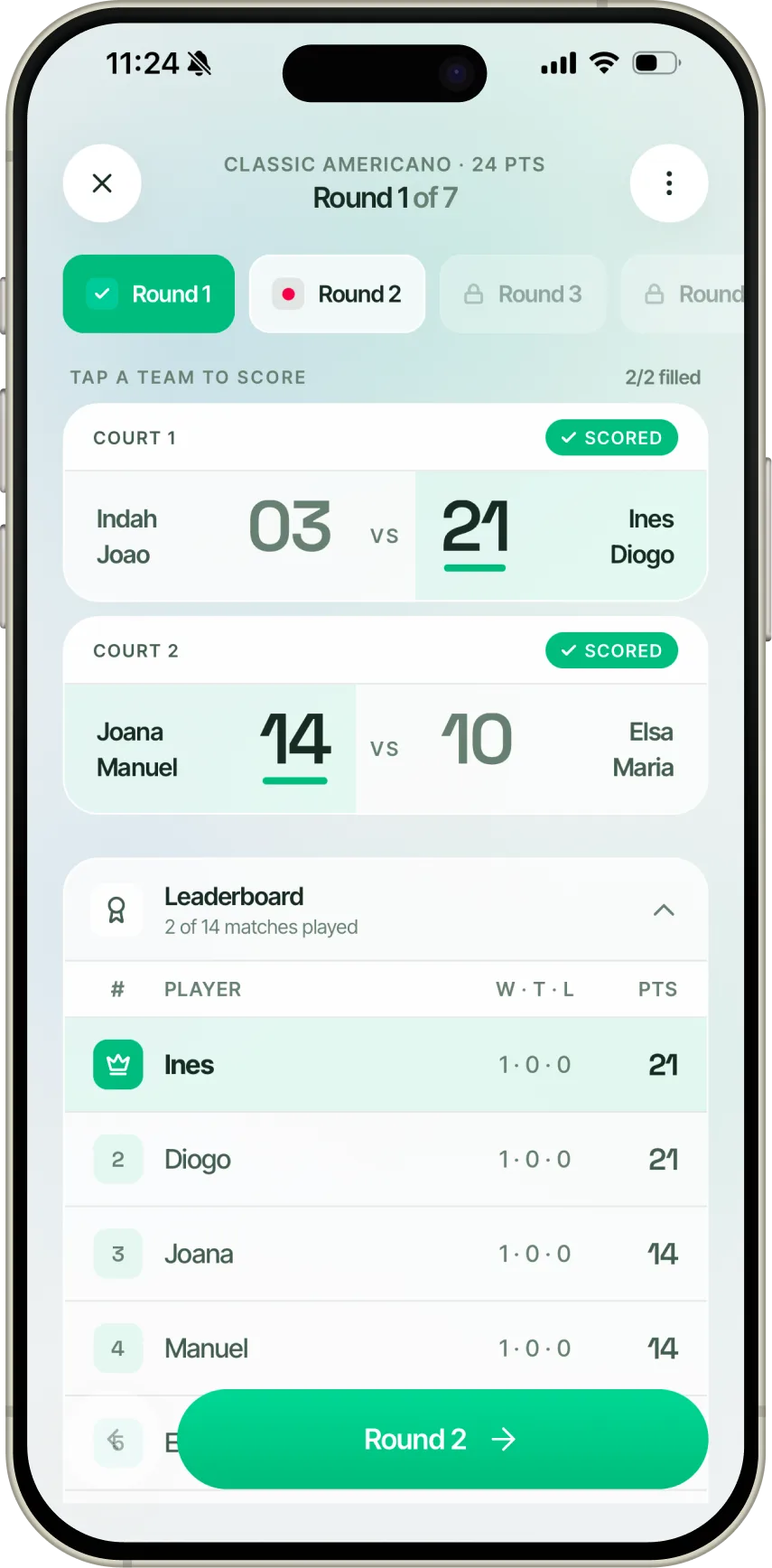
If you organise these nights, PadelEasy handles the admin: it draws the full rotation with partners and sit-outs balanced, suggests a points target from your session length so the last round ends on time, and updates the standings as scores come in from the court.
Frequently asked questions
Can the serve hit the wall in padel?
Yes, once it has bounced in the correct service box. It can then hit the glass and stay in play. If it hits the mesh fence before bouncing again, it is a fault.
Do you have to let the ball hit the wall?
No. The walls are an option, not an obligation. Apart from the return of serve, which must bounce first, you can volley the ball or play it after one bounce before it ever reaches a wall.
Can you hit the ball straight into the opponents’ wall?
Not directly. Your shot must bounce on their floor first. If it hits their glass or mesh before that, you lose the point.
Can you play padel one against one?
You can rally one against one, and some venues have narrower singles courts. The official rules and competitions, though, are for doubles.