How padel scoring works: points, games, sets and tie-breaks
Padel scoring explained: 15, 30, 40, deuce and advantage, golden point, how sets and tie-breaks work, and why an Americano counts points instead.

Padel scoring is tennis scoring with a couple of padel-specific choices. If you have ever followed a tennis match, you already know most of it: 15, 30, 40, game, and six games to win a set.
The differences are at deuce, where padel gives organisers three official options, and in the shorter match formats that help fit a match into a court booking. This guide covers the whole system, from the first point to a deciding tie-break, following the FIP Rules of Padel as they stand in 2026. For everything else that happens on court, see our beginner’s guide to padel rules.
Points: 15, 30, 40, game
Within a game, points are called like this:
| Points won | Score called |
|---|---|
| 0 | Love |
| 1 | 15 |
| 2 | 30 |
| 3 | 40 |
| 4 | Game |
The serving pair’s score is called first, so 30-15 means the servers are ahead and 15-30 means the receivers are.
The first pair to win four points takes the game. The exception is when both pairs reach 40. That is deuce, and what happens next depends on which deuce rule the match is using.
Deuce: three official options
Advantage
The traditional rule. At deuce, the pair that wins the next point has the advantage. If they win the following point too, they win the game. If they lose it, the score goes back to deuce.
A game under advantage scoring can look like this:
Deuce, advantage servers, deuce, advantage receivers, deuce, advantage servers, game servers.
There is no limit. The game only ends when one pair wins two points in a row from deuce, which is why a single advantage game can run on for a long time.
Golden point
At deuce, one deciding point is played, and whoever wins it wins the game. The receiving pair chooses whether to receive on the right or the left, but cannot swap positions to do it. In mixed matches, the player receiving must be the same sex as the server.
The World Padel Tour adopted the golden point in 2020 to shorten matches. It caps every game at seven points.
Star point
The newest option, added to the FIP rules for 2026. Two advantages are played as normal. If the score comes back to deuce a third time, a single deciding point, the star point, settles the game. Premier Padel and the FIP’s international circuits have used it since the start of the 2026 season.
It is a middle ground between the other two, and our guide to the star point rule compares all three in detail.
All three options are official. The organiser decides which one applies, so in a club match, agree it before the first serve rather than at 40-40.
Games and sets
The first pair to win six games takes the set, provided they are two games clear. So 6-4 wins a set, but 6-5 does not:
- At 5-5, play continues and 7-5 wins the set.
- At 6-6, a tie-break decides it, and the set goes down as 7-6.
A match is best of three sets. Some competitions announce in advance that the third set has no tie-break. In that case it carries on past 6-6 until one pair is two games clear.
The serve passes to the other pair after every game. At the start of each set, each pair decides which partner serves first, and that order holds for the whole set, so all four players serve once in every four games. Ends change after the first game of each set, then every two games after that (after games 3, 5, 7 and so on).
The tie-break at 6-6
How it is scored
Tie-break points are counted plainly: 1, 2, 3 and so on. The first pair to 7 wins, but they must be two points clear. At 6-6 the tie-break continues until one pair leads by two, so it can finish 8-6, 9-7 or 12-10.
Who serves
The player whose turn it is to serve starts the tie-break, and serves only the first point, from the right. The serve then passes to the other pair, whose next server serves two points, starting from the left. From then on, each player serves two points in turn, following the order used in the set.
Say Ana and Ben are playing Carla and Dev, and Ana is due to serve:
| Points | Server |
|---|---|
| 1 | Ana (from the right) |
| 2 and 3 | Carla |
| 4 and 5 | Ben |
| 6 and 7 | Dev |
| 8 and 9 | Ana |
The pair that received first in the tie-break serves first in the next set. In this example, that is Carla and Dev.
Changing ends
Change ends every six points: at 6-0, 5-1, 4-2 or 3-3, then again after twelve points, and so on. Play is continuous during a tie-break, so keep the changeovers quick.
Super tie-breaks and short sets
When court time is limited, a competition may shorten matches. The FIP rules include three alternatives:
- Super tie-break. At one set all, a tie-break to 10 points, won by two clear, replaces the third set. It works like a normal tie-break, just longer. You will also hear it called a match tie-break or a championship tie-break.
- Deciding tie-break to 7. The same idea, with a normal-length tie-break in place of the third set.
- Short sets. First to four games, two clear, with a tie-break at 4-4.
In Britain, for example, the LTA sets minimum match formats by tournament grade: three sets with a championship tie-break as the final set at national level, short sets to four games at regional and county level, and a single set at local level.
For a club league on a fixed booking, a super tie-break instead of a third set is the simplest way to keep matches within the booking. If you are setting up that kind of competition, see how to run a padel league.
How Americano scoring differs
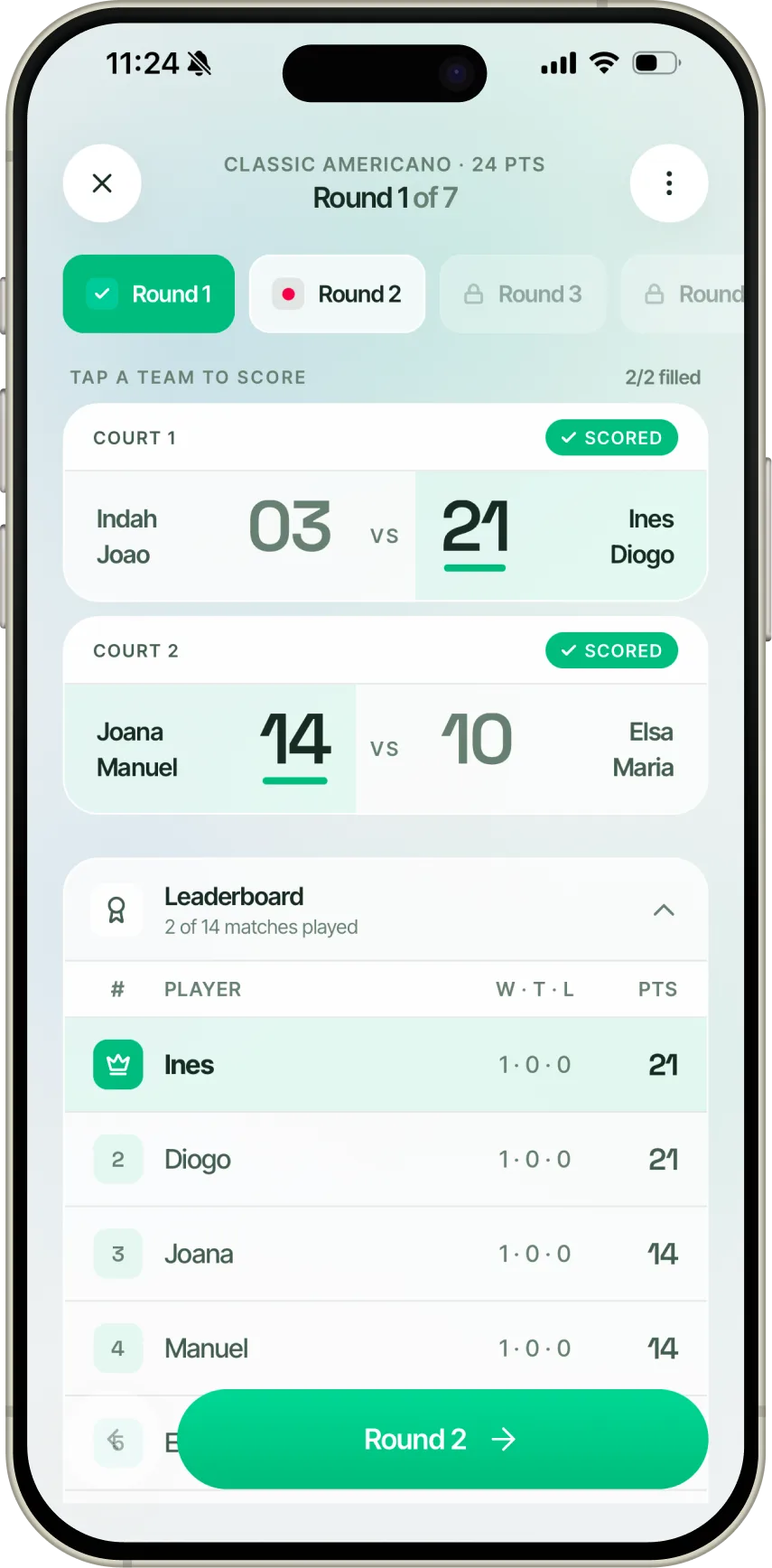
Points-based social formats like the Americano drop almost all of the above. Every rally is simply one point. There are no games, no sets and no deuce, so the choice between advantage, golden point and star point never comes up.
A round runs to a fixed total, such as 24 points, so both scores always add up to the target: 15-9, or 20-4. Every point also goes on your personal total, even in a match you lose. The logic behind that is in why an Americano counts points, not wins.
| Traditional match | Americano | |
|---|---|---|
| Scoring unit | Games and sets | Single points |
| At 40-40 | Advantage, golden point or star point | No deuce |
| Match length | Open-ended, unless sets are shortened | Fixed points total or a timer |
| Partners | Fixed | Change every round |
| Winner | Pair that wins two sets | Player with the most points overall |
If you run socials, PadelEasy is built for this points-based side of padel rather than for sets. You can play to a points target (the app suggests one from your session length, so the last round ends on time), run timed matches on a countdown, or keep open scoring, with every score entered from the court.
Frequently asked questions
Is the golden point used in padel?
Yes. It is one of three official deuce options in the FIP rules, alongside advantage and the star point. The organiser chooses which one a match uses.
How many points is a tie-break in padel?
A tie-break is first to 7 points, and a super tie-break is first to 10. Both must be won by two clear points.
Do you change ends during a tie-break?
Yes, every six points. There is no sit-down break, so change ends quickly and carry on.
Who serves first in the set after a tie-break?
The pair that received the first point of the tie-break.