Padel vs tennis: the differences that matter
Padel vs tennis compared: court size, walls, serve, rackets, balls, scoring and fitness, plus practical tips for tennis players switching to padel.

Padel is often described as tennis in a glass box, and that is about half right. The scoring is the same, the ball looks the same and plenty of tennis skills carry over. But the difference between padel and tennis shows up within minutes of your first game, usually when a ball you had given up on comes back off the glass.
This is padel vs tennis compared point by point, with what each difference means once you are on court.
The quick comparison
| Feature | Padel | Tennis |
|---|---|---|
| Court | 20 × 10 m (66 × 33 ft), enclosed | 23.77 × 10.97 m (78 × 36 ft) for doubles, open |
| Walls | Glass and mesh, part of play | None |
| Net at the centre | 88 cm (35 in) | 91.4 cm (3 ft) |
| Serve | Underarm, after a bounce, at or below waist height | Usually overhead |
| Racket | Solid, perforated, no strings, max 45.5 cm (18 in) | Strung, max 73.7 cm (29 in) |
| Ball | Slightly smaller, lower pressure | Higher pressure, livelier |
| Scoring | 15, 30, 40, sets to 6, often a golden point at deuce | 15, 30, 40, sets to 6, usually advantage |
| Format | Almost always doubles | Singles and doubles |
| Getting started | Slow rallies from the first session | Consistency takes longer |
The court and the walls
A padel court is 20 × 10 m. A tennis doubles court is 23.77 × 10.97 m, and it needs open run-off space around it on top of that. The widths are close. The real difference is what happens at the edges, and our guide to padel court dimensions has the full measurements.
It is also enclosed. The back walls are usually 3 m of glass with a metre of mesh on top, and the side walls are glass near the back and mesh for the rest. The net is a little lower than in tennis: 88 cm at the centre and 92 cm at the posts, against 91.4 cm and 107 cm.
The rule that matters most: once the ball has bounced on your side, it can hit the walls and stay in play. You can let it come off the glass and then return it, and you can even play it against your own wall to get it back over the net. The padel wall rules cover the details.
In tennis, a ball that gets past you is gone. In padel, it is often just the start of a longer rally. That is why defending is possible, why rallies tend to run longer, and why hitting harder does not automatically win the point.
Serve, racket and ball
The underarm serve
A padel serve is underarm. You bounce the ball behind the service line and hit it at or below waist height, with at least one foot on the ground, diagonally into the opposite box. As in tennis, you get a second serve. The walls add a wrinkle: a serve that lands in the box and then hits the glass is good, but one that hits the mesh before bouncing twice is a fault. Our guide to padel serve rules goes through the faults one by one.
Tennis allows an underarm serve too, but almost everyone serves overhead, and a big serve can win points on its own. In padel the serve starts the point. Placement matters far more than speed.
Rackets
A padel racket has no strings. It is a solid, perforated paddle, no longer than 45.5 cm, against a tennis maximum of 73.7 cm. The rules also require a safety cord on the handle, which goes round your wrist. The short, solid racket rewards compact swings rather than long tennis strokes.
Balls
Padel balls look like tennis balls, but they are slightly smaller and have lower internal pressure. The weight range is identical. The lower pressure makes them a little less lively, which suits a smaller court surrounded by glass. Use proper padel balls: tennis balls play faster than the game is built for.
Scoring: same system, two twists
If you can score tennis, you can score padel: 15, 30, 40, game, six games to win a set by two, a tie-break at 6-6, and usually best of three sets. The differences arrive at deuce.
- Golden point. At 40-40, one deciding point wins the game, and the receiving pair chooses which side receives it. It is widely used in club padel.
- Star point. Approved by the International Padel Federation in November 2025 and used on the professional tours from 2026. You play up to two advantages as normal, and if the game reaches deuce a third time, a single point settles it. Here is how the star point works in practice, and the FIP’s announcement has the official version.
Tennis has a close relative of the golden point in no-ad scoring, which is common in doubles.
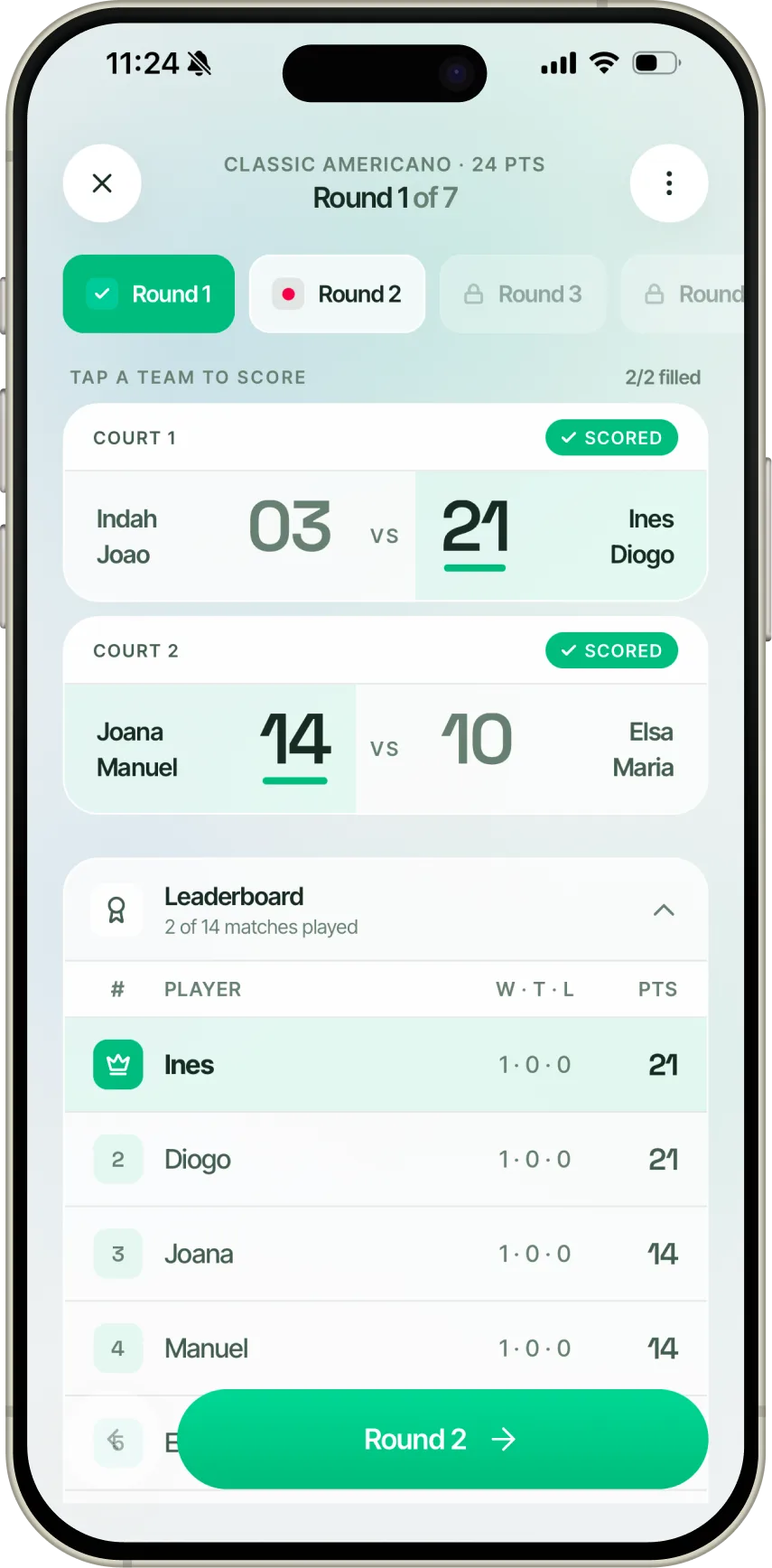
Social padel often skips games entirely. Americanos and Mexicanos are scored in points, playing to a target such as 24, so every round takes a predictable amount of time.
Learning curve and fitness
Padel is quicker to start. The court is smaller, the serve is underarm, the racket is short and the ball a little slower, so most newcomers can keep a gentle rally going in their first session. In tennis, getting to that point usually takes longer.
It gets harder later. Reading the ball off the back and side glass, and knowing when to attack and when to lob, is where padel skill really lies. Two players who strike the ball equally well can be a level apart because one of them understands the walls.
Physically, the demands are different rather than smaller. Each player covers roughly half of a 10 m wide court, so there is less running than in singles tennis. The movement is short and sharp instead: quick changes of direction, lots of bending for low balls off the glass, and no overhead serve. Played competitively, it is still hard work.
Doubles and the social side
Padel is almost always played as doubles. Singles exists, sometimes on a narrower 6 m court, but you will rarely see it at a club. Tennis is played both ways.
That shapes the whole culture. Four players share a small enclosed court, close enough to talk between points. Rallies are longer, errors are shared, and a weaker player can still contribute by keeping the ball in play. It is why padel clubs lean so heavily on social formats like the Americano, where partners rotate every round and everyone plays all evening. If you end up organising one, PadelEasy draws the rotation, takes the scores from the court and keeps the standings.
Tips for tennis players
Tennis players usually pick padel up fast, because volleys, overheads and footwork transfer well. The habits that hold them back are predictable:
- Let the ball come off the glass. Your instinct is to take every ball early, including awkward half-volleys. Let it hit the back wall, turn with it, and play it as it comes out. It feels slow at first, then it becomes your best defence.
- Lob more than you think you should. The pair at the net controls the point. A deep lob over their heads is how you win the net back, and in padel it is a normal attacking shot, not a desperate one.
- Take pace off. A hard drive into the back glass just comes back to your opponents. A flat, full-power smash often does the same unless it leaves the court entirely. Padel players use controlled overheads like the bandeja instead, and our guide to padel shots explains them.
- Shorten the swing. The racket is short and the court is small. Compact strokes, especially at the net, keep more balls in play.
- Move as a pair. Stay level with your partner: both at the net or both back. The gap that opens when one of you drifts is where points are lost.
- Serve to get to the net. Aim for placement, then follow the serve in.
Frequently asked questions
Is padel easier than tennis?
Easier to start, yes. The underarm serve, smaller court and short racket mean beginners rally sooner. Getting good still takes time, and in padel most of it goes into learning the walls.
Can you use a tennis racket or tennis balls for padel?
Not for a proper game. The rules require a solid, stringless racket, and padel balls have lower pressure than tennis balls, which keeps the game at the right speed off the glass.
Is padel scoring the same as tennis?
Yes, points, games and sets work the same way. The differences are the golden point or star point at deuce, and social formats that count points instead of games.
Do tennis players make good padel players?
Usually, and quickly. Volleys, overheads and footwork carry across. The adjustment is patience: letting the ball come off the glass and resisting the urge to hit everything hard.