How to organise a padel tournament, step by step
How to organise a padel tournament from first idea to final photo: format, court maths, levels, entries, scoring, running the day, plus a checklist.

Learning how to organise a padel tournament is mostly learning what to decide before anyone hits a ball. Who it is for, which format, how the numbers fit your courts, how people will know where to go: settle those early and the day runs itself. Leave them to the day and you spend the evening with a pen, a whiteboard and a queue of questions.
Here are those decisions step by step, in the order they need making. They work for eight friends on a Friday night and for a club day with 16 pairs. The numbers change; the order does not.
1. Decide who it is for
Every other decision follows from one question: is this a social or a competition?
A social (a club night, a group of friends, a work event) succeeds when everyone plays a lot, meets new people and goes home on time. A competition (a club championship, a ranked event) succeeds when the winner is clearly the best pair on the day.
| Social | Competition | |
|---|---|---|
| Entry | Individuals | Fixed pairs |
| Formats | Americano, Mexicano | Groups, knockouts |
| Scoring | Points to a target | Games and sets |
| Levels | Mixed is fine | Split by level |
| Length | One booking slot | Half or full day |
Then look at who is actually coming. Beginners at a company event need a two-minute rules briefing and nothing that knocks anyone out; our guide to corporate padel events covers that case. Regulars who play three times a week want tension, which points you towards a Mexicano or a proper draw.
Write the goal down in one sentence, for example: “16 members, mixed levels, two hours, everyone plays every round, finished by 9pm.” Every decision below gets checked against it.
2. Choose the format
The format decides who partners whom, who plays whom and how the winner is decided. The short version:
- Americano: partners rotate on a schedule drawn before the first serve, and every point counts for you individually. The default for socials and mixed levels.
- Mexicano: each round is drawn from the live standings, so matches get closer as the night goes on. Best for competitive groups of similar level.
- Round robin or groups: fixed pairs play each other, often followed by a knockout for a proper final.
- Knockout: lose and you are out. Add a consolation draw so nobody travels to play once.
- King of the Court: winners move up a court, losers move down.
Each one is covered with player counts, timings, pros and cons in our comparison of padel tournament formats. If you are still unsure, run an Americano: it is the easiest to explain, copes with mixed levels and has a known end time. If you are torn between the two social formats, Americano vs Mexicano will settle it.
PadelEasy runs the Americano and Mexicano families in Classic, Mixed, Team and Club versions, eight formats in all. Each one has its own page in the format guides.
3. Do the court maths
Players and courts
Padel is doubles, so each court takes four players a round.
- Courts needed: players divided by four, rounded down. With fixed pairs, it is two pairs per court.
- Anyone left over sits out that round, so the rotation has to share the rests fairly.
- Multiples of four (8, 12, 16) mean nobody sits out. Aim for one when you set the entry cap.
Time per round
Points formats are quick and predictable: a match to 24 points takes roughly 12 to 15 minutes, including the changeover. Games and sets are much slower. Match analysis of competitive padel puts an average set at a little over 30 minutes, so allow about 40 minutes a slot for a one-set match once you add the warm-up and changeover.
Then work backwards from the booking:
16 players, 4 courts, 2 hours booked. Take off 10 minutes for arrivals and the briefing, leaving 110 minutes. At 14 minutes a round, that is 7 rounds of an Americano to 24 points.
8 pairs, 2 courts, two groups of four and a knockout. The groups need 12 matches, plus 2 semi-finals and a final. That is 8 slots of 40 minutes: over five hours of court time.
That second number is why sets belong to events with a whole day, and points to events with one booking. For the points version in more detail, see our organiser’s checklist for an Americano.
Booking the courts
- Book every court for the same block, so all rounds start and finish together. Neighbouring courts help: you can see every match from one spot.
- Add 10 to 15 minutes at the start for arrivals, warm-up and the briefing.
- Book early. A tournament needs several courts at once, and busy clubs fill their evening slots first.
- Plan to finish early. Aim for the last round to end 5 minutes before the booking does, so nobody rushes the final.
4. Sort levels and entries
Levels and seeding
For a social, an Americano absorbs a fair spread of levels, because partners rotate and points are individual. A very wide spread is different: a beginner facing two strong players has a miserable round. If the gap is that big, split the night into two groups on separate courts, for example improvers on courts 1 and 2 and stronger players on 3 and 4.
A shared scale helps. Many players already have a Playtomic level, which runs from 0 to 7, and our padel levels guide helps players who are not sure where they sit. A Mexicano needs less of this: after a round or two, the standings sort players by level on their own.
For a competition, seed the strongest pairs so they cannot meet early. In a group stage, spread them with a snake: seeds 1 to 4 head groups A to D, seeds 5 to 8 go into groups D to A, and so on. For a mixed event, decide upfront whether every pair must be one man and one woman.
Entry and registration
- Decide what people enter as: individuals for rotating formats, pairs for groups and knockouts.
- Cap the entries at what your courts can take, and keep a reserve list. Plan for at least one late dropout.
- Collect only what you need: the name to show on the standings, level, gender if the format is mixed, partner for pairs events, and a phone number for the day.
- Close entries a day or two before, so you have time to fix awkward numbers.
- Take any entry fee upfront. It is the simplest cure for no-shows.
A booking platform’s event page, a simple form or a group chat all work for collecting names. PadelEasy does not take entries or payments. Once the list is final, you type or paste the names in, or import them from a Playtomic link.
5. Set the scoring and schedule
Scoring and match length
| Scoring | How it works | Best for |
|---|---|---|
| Points target | Play to 16, 24 or 32 points | Americano, Mexicano |
| Timed | The score at the whistle stands | Keeping courts in sync |
| One set | Games, often golden point | Group stages |
| Best of three | Full sets and tie-breaks | Finals, ranked events |
For socials, a points target is hard to beat: matches take roughly the same time, and every point counts. For games and sets, decide how deuce works before the first match. Golden point, one deciding point at 40-40, keeps games short. The newer star point rule allows two rounds of advantage before a deciding point.
For ranked events in the UK, the LTA publishes the draw and scoring formats for its sanctioned tournaments. The minimum scoring is one set at Grade 5 and short sets to four games at Grades 3 and 4.
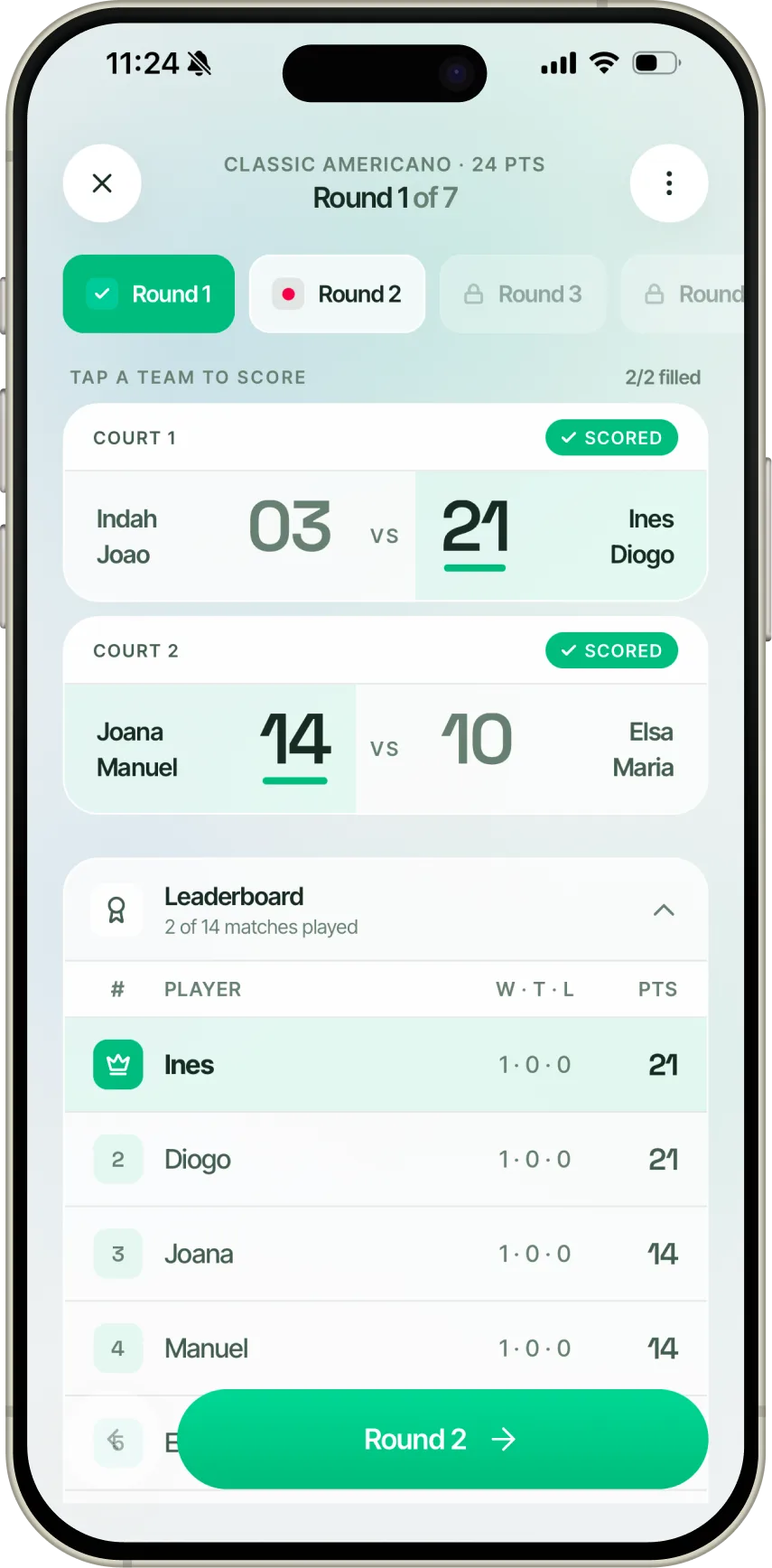
In PadelEasy you choose between a points target, timed matches on a countdown from 5 to 60 minutes, or open scoring. For a points target, the app suggests one from your session length so the last round ends on time. It does not score games, sets or tie-breaks, so for a sets event keep score on paper or with a tool built for it.
Schedule and sit-outs
- Show round 1 before people arrive, or at the latest before the briefing ends.
- Rotate sit-outs fairly. Nobody should rest twice before everyone has rested once, and resting players should know exactly when they are back on.
- Decide the latecomer rule now. The simplest is that the draw happens at the briefing with whoever is there. Put it in the invite so nobody is surprised.
- Leave slack. If rounds run fast you can add one at the end; if they run slow, you cannot claw the time back.
This is the part PadelEasy takes off your hands. The full rotation is drawn in one tap, on any number of courts, with partners, opponents and sit-outs balanced. In a Mexicano, each round is redrawn from the live standings as soon as the last score is entered. If there is time left at the end, add an extra round.
6. Run the day
The two-minute briefing
Gather everyone before the first serve and cover five things: the format, the scoring, the finish time, how to report scores and where to see the standings. For an Americano it can be this short:
Seven rounds to 24 points, finishing at 9pm. New partner every round. Every point you score goes on your own total, so play out every rally. When your match ends, report the score straight away. Standings are on the screen and on the link in the group chat.
A visible schedule and live standings
All night, players want to know two things: where they play next, and how they are doing. Answer both without becoming the bottleneck. A whiteboard works for a fixed schedule, and fails the moment you redraw a round or someone leaves early.
In PadelEasy, share the live link in the group chat, or put its QR code where people gather. Anyone can follow scores and standings in a browser, with no login or install, and the same link can go on the club TV.
Balls and equipment
- Balls: open a fresh tube of three per court for anything competitive, and new ones again for a final.
- A timer or horn for timed rounds, loud enough for every court.
- A charged phone and a power bank, if the tournament runs on one.
- Water, towels and spare rackets for newcomers, plus a paper copy of round 1 as a backup.
7. Prizes, photos and afterwards
Prizes and photos
Keep prizes small and quick to hand out. For a mixed-level social, add one that is not about being the best, such as a random draw or the group’s vote for rally of the night, so everyone has a chance. Decide the tie-break rule before the last round. In PadelEasy, level totals are split by point difference, then by match wins.
Take the group photo at the start, while everyone is still there and still fresh. At the end, PadelEasy’s share cards lay the standings or the winner over your photo, ready for Instagram stories.
After the event
- Send the final standings to the group the same evening.
- Ask one question: what would you change next time?
- Note how long rounds actually took, and plan the next one with the real numbers.
- Announce the next date while everyone is still together.
The organiser’s checklist
Two weeks before
- Goal written down in one sentence
- Format chosen
- Courts booked for the same block, plus 10 to 15 minutes
- Entries open, with a cap and a closing date
The week before
- Entries closed and a reserve list ready
- Levels checked; groups or seeds set
- Scoring, round length and tie-breaks decided
- Prizes sorted
On the day
- Balls, water, timer and a charged phone
- Round 1 visible before the briefing
- Briefing done in two minutes
- Live standings on a screen or a shared link
Afterwards
- Results and photos sent
- Feedback collected
- Next date announced
Frequently asked questions
How many players do you need for a padel tournament?
Four per court per round. Eight players on two courts is the classic social, and any multiple of four means nobody sits out. Fixed-pair events work from four pairs upwards.
How long does a padel tournament take?
A social Americano for 8 players takes about two hours. A fixed-pair event with groups and a knockout, played in sets, can fill a whole day.
What is the best format for a padel tournament?
For socials, an Americano. For competitive groups of similar level, a Mexicano. For fixed pairs, groups followed by a knockout.
Do you need an app to run a padel tournament?
No. Eight players and a whiteboard can work. An app earns its place when the numbers get awkward, sit-outs need sharing or you want live standings without running around, which is the job PadelEasy does.