How to run a padel club night people come back to
Run a padel club night people return to: a fixed weekly slot, a waitlist, level bands, the right format, a short briefing and results shared that night.

Filling a padel club night once is easy. Filling it every week, with the same regulars and a few new faces, takes structure. Almost all of it is decided before anyone hits a ball: when you play, who gets a place, how you handle levels and what happens between rounds.
Here is a setup that works for a weekly padel social, from the sign-up list to the photo at the end.
A fixed slot and a waitlist
Pick one evening, one start time and one length, and keep them. “Thursdays, 7 to 9pm” is something people plan their week around. A night that moves every week has to be sold again every week.
If the club allows it, block-book the courts for the season so the slot never disappears.
Take sign-ups wherever your players already are: the club’s booking app, a WhatsApp poll or a simple form. Then add three rules:
- Cap the list at a multiple of 4. That is 8 players for two courts, 12 for three and 16 for four. Everyone plays every round.
- Open and close at the same times each week. For example, open on Monday morning and close at noon on the day. People learn when to act.
- Ask for a firm yes 24 to 48 hours before. It flushes out the maybes while there is still time to fill the gaps.
Once the cap is reached, everyone else goes on a waitlist in sign-up order. When someone drops out, the next name gets the place and hears about it straight away. The waitlist also tells you when to grow: if it is four deep most weeks, book another court and open four more places.
Levels and formats
The quickest way to lose players is a night of 24-3 scorelines. You have two ways to handle level.
Level bands. Split the night into groups, each with its own courts and its own tournament. If your club uses Playtomic, you can band by its 0 to 7 level scale, for example one group from 1.5 to 3.0 and one from 3.0 to 4.5. With sixteen players, two bands of eight each get the full 7-round rotation on two courts. Our guide to padel levels explains what the numbers mean on court.
Let Mexicano sort it. If you cannot split the group, a Mexicano does the sorting for you. Round one is random, then every round is redrawn from the standings, so the stronger players drift onto the same court and matches everywhere get closer within a few rounds. An Americano handles a wide spread differently: it shares strong and weaker partners out evenly over the night, which keeps the table fair but allows the odd lopsided match.
Then match the format to the group in front of you:
| Your group | Format to run |
|---|---|
| Drop-in group, mixed levels | Classic Americano |
| Regulars who want close matches | Classic Mexicano |
| Equal numbers of men and women | Mixed Americano or Mixed Mexicano |
| Players who arrive as fixed pairs | Team Americano or Team Mexicano |
| Two clubs or two groups meeting | Club Americano or Club Mexicano |
If in doubt, run an Americano. It is the easiest to explain and the easiest to join for the first time. The trade-offs are covered in Americano vs Mexicano, and all eight formats are on the formats page. For a mixed night, see our guide to running a mixed padel tournament.
Timing a 90 or 120 minute night
Work backwards from the booking. Take 10 to 15 minutes off for the warm-up and briefing, then divide what is left by your round length. A round to 24 points takes roughly 12 to 15 minutes including the changeover. The full method is in our Americano organiser’s checklist.
For eight players on two courts:
| Booking | What fits |
|---|---|
| 90 minutes | 5 rounds to 24 points, or all 7 rounds to around 16 |
| 120 minutes | All 7 rounds to 20 points, so everyone partners everyone once |
A two-hour night might run like this:
| Time | What happens |
|---|---|
| 18:50 | Doors open, names ticked off |
| 19:00 | Courts open for a knock-up |
| 19:10 | Briefing |
| 19:15 | Round 1 |
| About 20:50 | Last round ends, final standings |
| 21:00 | Off court, food and drinks |
PadelEasy suggests a points target from your session length so the last round ends on time. It can also run timed matches on a countdown, which keeps every court on the same clock. If you finish early, add an extra round rather than sending people home.
Briefing, sit-outs and latecomers
Keep the briefing under three minutes and say the same five things every week:
- The format, the points target and the finish time.
- Every point you score counts for you, even in a loss. It is the rule that keeps people playing hard at 20-4 down.
- Where to find your next court: the screen, or the live link on your phone.
- Report your score to the organiser the moment your match ends.
- The rule for rests and late arrivals.
Regulars will know it by heart after a month. It is for the new faces.
Sit-outs. A list capped at a multiple of 4 means nobody rests. When a late dropout leaves you one short, promote from the waitlist. If nobody can come, the host plays, so bring your racket every week. If you do end up with an awkward number, PadelEasy rotates the rests so they are shared fairly.
Latecomers. Start on time, every time. If you wait for the player who is always ten minutes late, everyone learns to be ten minutes late. Put the rule in the invite: the draw happens at the briefing with whoever is there. If the host is filling a gap, a latecomer can take over from the next round, points and all.
Keep the scores visible
A dozen players crowding round one phone to find out who is on court 2 is where a night loses its rhythm. Make the draw and the standings visible to everyone.
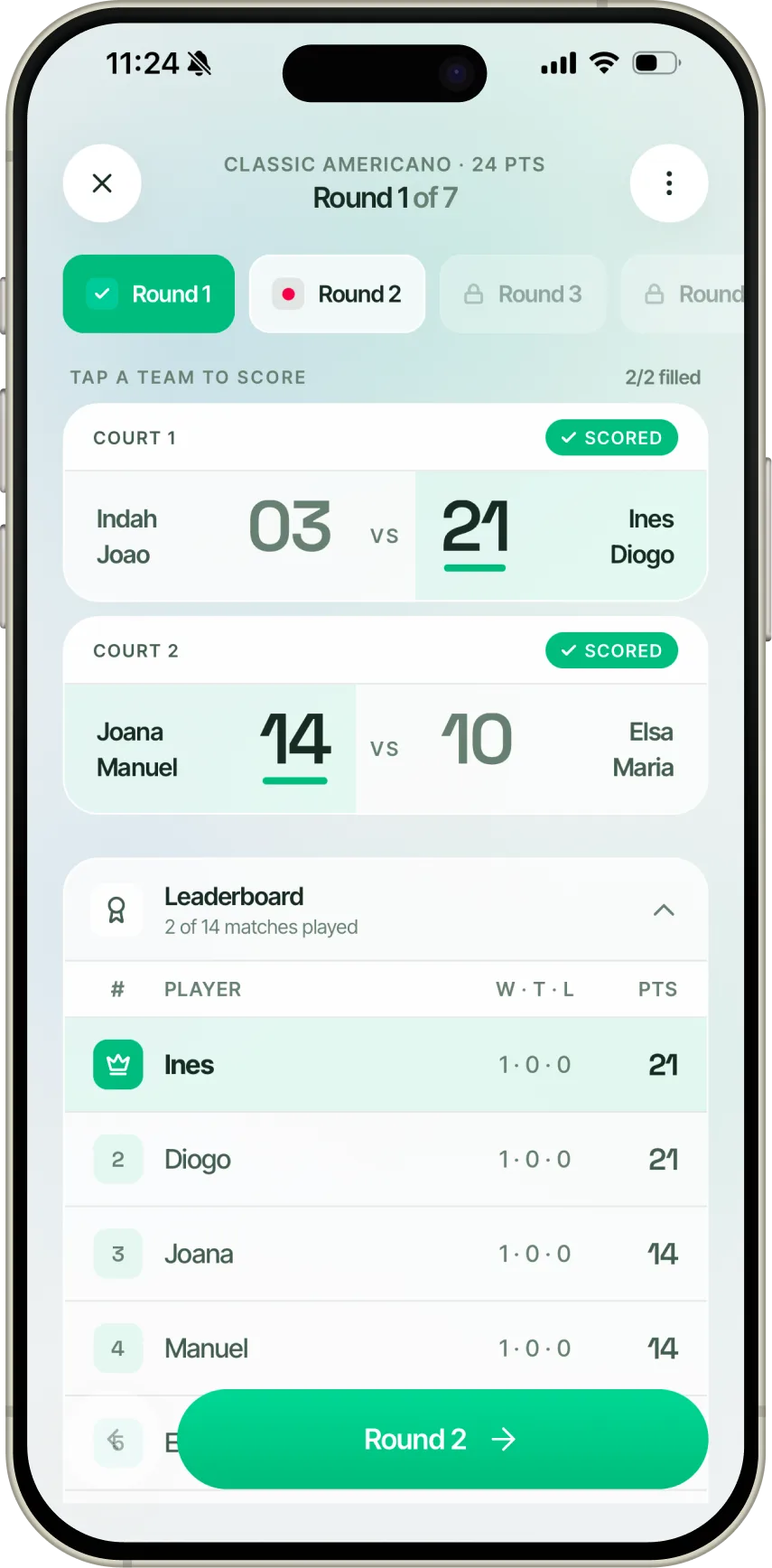
- Put the standings on a screen. Every PadelEasy tournament has a live link and QR code that opens in any browser with no login or install, so the club TV can show every court and the standings all night.
- Stick the QR code up by the courts and at the bar. Players check their next court on their phones, and friends can follow along without asking.
- Enter results as courts finish. In PadelEasy the organiser taps each score in from the court side and the next round is ready straight away, so nobody stands around waiting.
A live table also keeps the last round meaningful: players can see exactly what they need to catch the leader.
The social side
The padel gets people through the door. What happens around it brings them back.
- Music: on, but low enough that partners can hear each other call the ball.
- Food and drink: agree a regular deal with the bar and hold a table for when the courts close. LTA Padel’s piece on why padel is so sociable describes the same shape at Padel Maidenhead’s Friday night Hit & Mix: players are partnered up for two hours of padel, then drinks.
- Results the same night: post the final standings in the group chat before people get home.
- The photo: take a group shot at the end. PadelEasy turns it into a share card with the standings or the winner laid over it, sized for Instagram stories. Tag the club, and check before posting anyone who would rather stay offline.
Keep regulars, welcome newcomers
A club night needs both. Regulars make it reliable, and new players keep it alive.
- Hold one or two places each week for first-timers, so the night never quietly becomes a closed group.
- Introduce new players by name at the briefing, and make sure they know the scoring before round one.
- Message first-timers the next day with the results and next week’s sign-up.
- Change the format now and then: a Mexicano night, a mixed night, a club-versus-club night. Regulars get something new without losing their slot.
- Keep the weekly night open. If the regulars want a season-long table, that is a league with its own rules, covered in how to run a padel league.
Frequently asked questions
How many players do you need for a padel club night?
Eight on two courts is the easiest start: 7 rounds, and everyone partners everyone once. Any multiple of 4 means nobody sits out.
How long should a padel club night last?
Plan for 90 minutes or 2 hours. Two hours fits the full rotation for eight players plus a warm-up and briefing, while 90 minutes needs shorter matches or fewer rounds.
What is the best format for a padel social?
An Americano for groups that change week to week or have mixed levels. A Mexicano when the group is similar in level and there to compete.
Does PadelEasy handle sign-ups and payments?
No. Keep taking bookings the way your club already does. PadelEasy takes over once the list is final: type or paste the names, or import them from a Playtomic link, and the draw is ready in one tap.