How to run a padel league or ladder at your club
How to run a padel league at your club: box leagues, ladders, scheduling, scoring and no-shows, plus a weekly league night that is far easier to manage.

A padel league gives members a reason to play every week and a table to talk about. It is also the kind of club event that stalls in week three, when half the fixtures are unbooked and nobody is sure who was meant to chase whom.
Most of that is decided before the first match: the format, who books the courts, how matches are scored and what happens when someone does not turn up. Here is how to make each call, whether you are setting up a box league, a padel ladder or something much simpler.
Three ways to run it
The three common formats differ mostly in how much chasing they need.
| Format | How it works | Admin | Best for |
|---|---|---|---|
| Box league | Small groups play everyone in their group by a deadline. The top move up, the bottom move down. | Medium | Members who can book their own courts |
| Ladder | A ranked list. Challenge someone above you; beat them and take their place. | Medium | Competitive pairs who want to play on their own schedule |
| League night | Same night, same courts, every week. An Americano or Mexicano each time, totalled over a season. | Low | Social clubs and busy players |
How a box league works
A box league splits entrants into small groups of similar level, usually four to six pairs or players per box. Everyone plays everyone else in their box within a set window, commonly four to six weeks. At the end of the round, the top one or two move up a box, the bottom one or two move down, and the next round starts.
Box size decides how hard the round is to finish:
| Box size | Matches per entrant | Matches per box |
|---|---|---|
| 4 | 3 | 6 |
| 5 | 4 | 10 |
| 6 | 5 | 15 |
Every padel match needs four diaries to line up, so five matches in a month is a lot to ask. Start with boxes of four and only grow them if people keep up.
Seed the first round by level. A Playtomic number, a coach’s view or last season’s results all work, and our guide to padel levels explains what the numbers mean. Promotion and relegation will fix most seeding mistakes within a couple of rounds.
How a padel ladder works
A ladder is a single ranked list with no fixed fixtures. You challenge someone above you. Win and you take their place, with everyone in between dropping one spot. Lose and nothing changes.
Club ladders vary, but the rules that keep them moving are much the same:
- Challenge range. Up to three places above you is typical. Some clubs allow five.
- Response time. The challenged pair must accept, or offer dates, within 48 hours.
- Play-by date. The match is played within 10 to 14 days. If the challenged pair will not play in time, the challenger takes the place.
- New entrants start at the bottom.
- Inactivity. Pairs who go a month without playing drop places, so nobody can sit at the top by avoiding matches.
Ladders suit fixed pairs. An individual padel ladder needs rules about who partners whom in every challenge, which is usually where they get complicated.
Fixed pairs or individuals
This choice shapes everything else.
Fixed-pair leagues are the simplest to run: one entry per pair, one line in the table, and a result is a result. The weakness is availability. If one partner is injured or away, the pair cannot play, so let each pair name a reserve of the same level or lower for a limited number of matches.
Individual leagues suit social clubs, because partners rotate and nobody needs a partner to enter. The neatest version is a box of four players who meet for one evening and play three sets, one with each possible partnership: A and B against C and D, then A and C against B and D, then A and D against B and C. Each player keeps their own games total. One booking covers the whole box, which also solves the four-diaries problem.
If you want fixed pairs but prefer one evening to self-booked fixtures, Team Americano keeps pairs together and rotates the opponents.
Scheduling, scoring and results
Scheduling. Either players book their own matches within the window, or you book courts for fixed league nights. Self-booking is flexible, but completion depends on the least organised pair in each box, so make one side responsible for the first message (the higher-placed pair, say) and give it a deadline. Fixed nights are less flexible, but the matches actually happen.
Match format. Best of three sets, with a match tie-break (first to 10, two clear) instead of a full third set, is common in club leagues because it keeps matches to a predictable length. Golden point at deuce shortens games further, and the FIP’s new star point is a middle ground. If courts are tight, a single set or a race to a points target also works. Whatever you pick, use it for every match, and send anyone unsure to our padel scoring guide.
League table. Keep it simple: 3 points for a win, 1 for playing and losing, 0 for not turning up. The point for losing rewards people for playing, and people playing is what keeps a league alive. Break ties on head-to-head, then sets, then games.
Results. One place and one owner. The winning side reports the full score within 24 hours, in a shared spreadsheet or form rather than scattered across group chats, and the table is updated on a fixed day each week.
No-shows and season length
Publish your no-show rules before the first match. The ones that work:
- Late cancellation or no-show. The other side gets the win, recorded as a straight-sets victory.
- Unplayed by the deadline. If one side can show it offered dates, it takes the win. If neither can, nobody scores.
- Repeat absences. Anyone who completes fewer than two matches in a round misses the next one, unless there is a good reason.
- Reserves. Keep a short list of players happy to fill in, especially for individual leagues.
Shorter seasons finish better. A box league round of four to six weeks, repeated two or three times, makes a good season. Ladders can run all year, but a three-month season with a final table gives people a finish line. For league nights, eight to ten weeks is enough to crown someone before holidays thin the numbers.
The easier option: a league night
Box leagues and ladders usually depend on players arranging their own matches, and that is where they tend to stall. A weekly league night removes the problem. Same night, same courts, every week, and you run an Americano or Mexicano with whoever turns up.
- Book the courts for the season. Two courts suit 8 players a night; three suit 12.
- Register a bigger squad. For two courts, sign up 12 to 14 names so that a few absences still leave you with 8.
- Pick a format. Americano for a mixed group, Mexicano if you want the strongest players meeting each other by the end. Our Americano vs Mexicano comparison helps you choose.
- Add each night to a season table.
Numbers do not have to be perfect. With 10 players on two courts, two sit out each round, and a well-drawn rotation shares the rests fairly. A Mexicano night is also a box league squeezed into one evening: after every round, players move up or down depending on their results.
Turning nights into a season table
Missed weeks are the main headache, so choose a method before week one:
| Method | How it works | Watch out for |
|---|---|---|
| Total points | Add up each player’s points from every night | Rewards attendance, and sit-outs cost points |
| Finishing position | League points by place each night, such as 10 for 1st and 9 for 2nd | Winning a night of 8 counts the same as a night of 16 |
| Points per round | Total points divided by rounds played | Set a minimum, such as 5 nights, to qualify |
Points per round is the fairest if you keep the points target the same every week, because it ignores sit-outs and missed nights. For something simpler, count each player’s best 6 of 8 nights under whichever method you choose.
Where PadelEasy fits
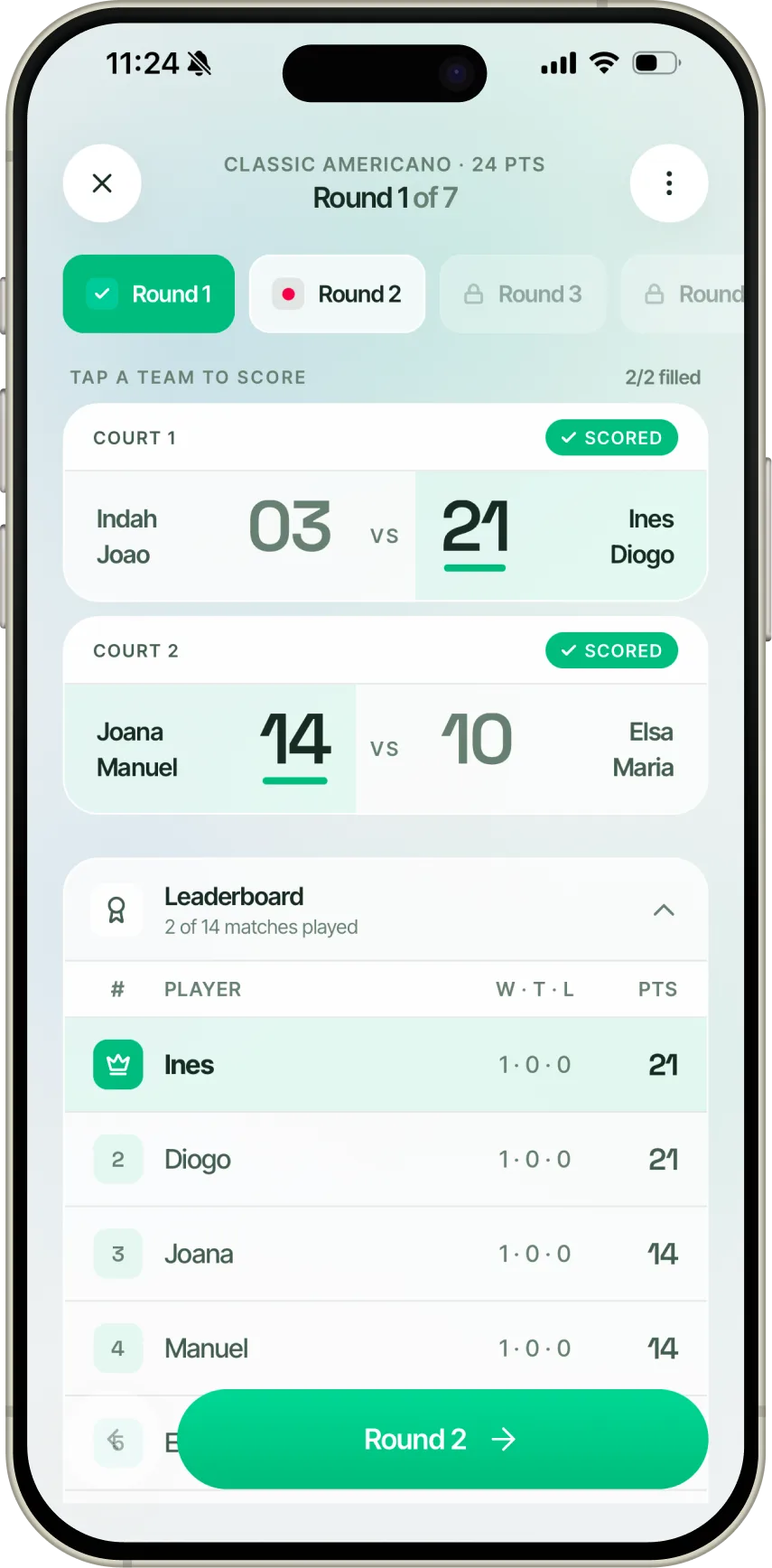
Be clear about what does what. PadelEasy runs the night: the full rotation drawn in one tap with sit-outs balanced, scores entered from the court, Mexicano rounds redrawn from the live standings, and a live link anyone can follow, including on the club TV. It does not keep standings across weeks. The season table lives in a spreadsheet, and after each night you copy the final standings across, which takes a couple of minutes.
For the evening itself, our guide on how to run a padel club night covers the rest.
Frequently asked questions
What is a box league in padel?
A league split into small groups of similar level, usually four to six pairs or players. Everyone in a box plays each other by a deadline, then the top move up a box and the bottom move down.
How many players do you need for a padel league?
Two boxes of four is a workable minimum, so 8 pairs or 8 individuals. A league night needs 8 players on the night for two courts, which usually means a squad of 12 or more.
How long should a padel league season be?
For a league night, eight to ten weeks. For a box league, two or three rounds of four to six weeks. Either is long enough for the table to mean something and short enough that people finish what they started.
Can PadelEasy run a padel league?
It runs each league night’s Americano or Mexicano, with live standings for that night. It does not track results across weeks, so keep the season table in a spreadsheet.